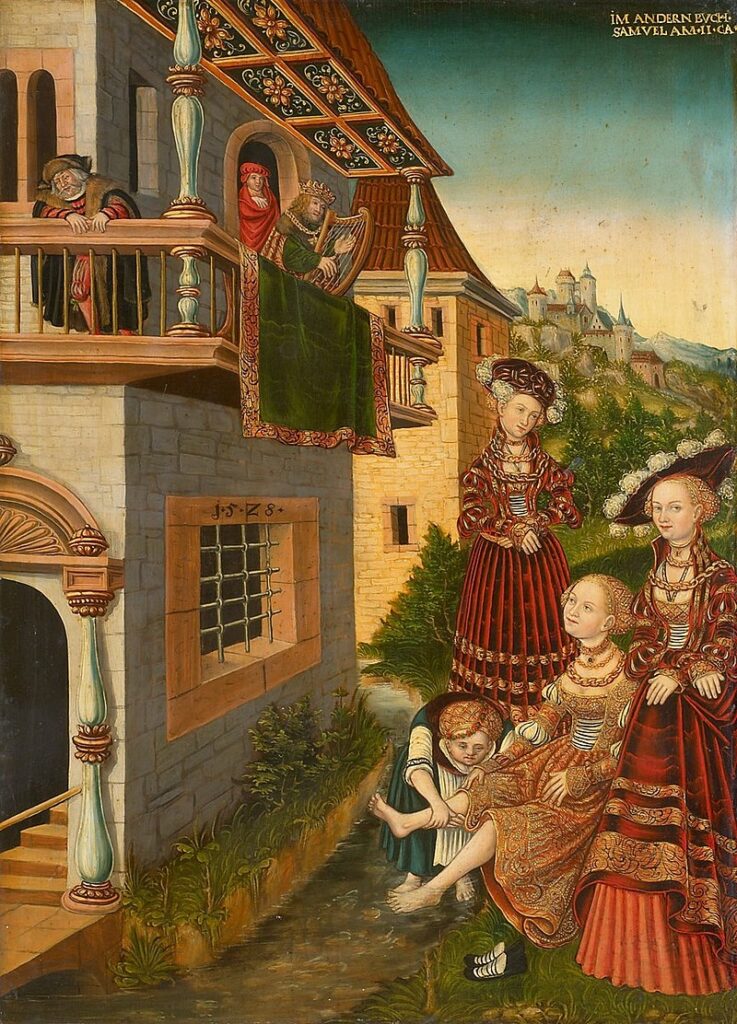
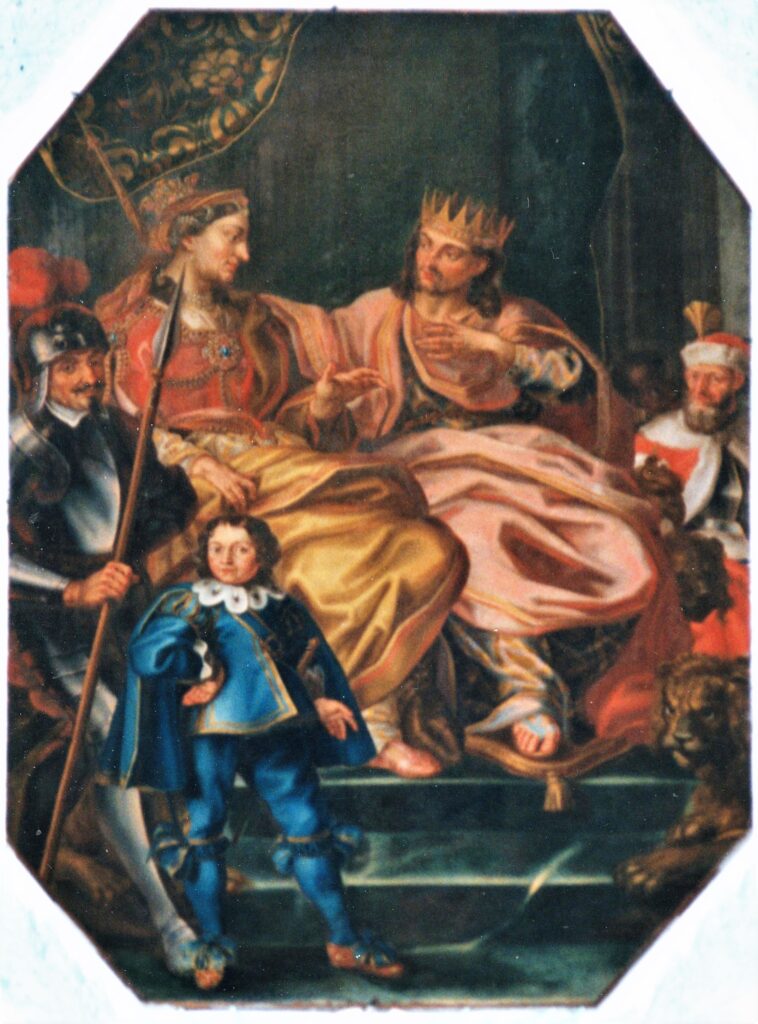
In the fall of 2024 as I was studying for a class I was teaching, I began a deep dive into the life and legacy of Bathsheba. What I found was a profound picture of redemption that is so the polar opposite of the wily temptress that many have understood her to be. Here are two sermons from my book, Portraits of Faith, that I preached about Bathsheba and how her faith in God was rewarded by a wonderful outpouring of God’s grace. – MBG
THE FAITH OF BATHSHEBA
PART I
1 The book of the generation of Jesus Christ, the son of David, the son of Abraham. 2 Abraham begat Isaac; and Isaac begat Jacob; and Jacob begat Judas and his brethren; 3 And Judas begat Phares and Zara of Thamar; and Phares begat Esrom; and Esrom begat Aram; 4 And Aram begat Aminadab; and Aminadab begat Naasson; and Naasson begat Salmon; 5 And Salmon begat Booz of Rachab; and Booz begat Obed of Ruth; and Obed begat Jesse; 6 And Jesse begat David the king; and David the king begat Solomon of her that had been the wife of Urias; – Matthew 1:1-6
Our text is a portion of the genealogy of Christ as recorded by Matthew. One of the interesting features of this genealogy, especially when compared to the one given in Luke 3, is that it includes four women. Each of these women has an interesting story to tell.
First, and I think the most bizarre of any of them, is Tamar. She had to trick her father-in-law Judah to fulfill the Levirate marriage custom in Genesis 38.
Second is Rahab. She was the harlot that harbored the Jewish spies in Jericho in Joshua 2 and was spared when that city fell in Joshua 6.
Third is Ruth. She was the Moabite girl that returned home with her mother-in-law Naomi. We have a whole book in the Bible devoted to her story.
Fourth is Bathsheba.
Bathsheba’s name is not given here in Matthew’s genealogy, only that she had been the wife of Uriah and had given birth to David’s heir Solomon. There are theories as to why she is mentioned but not by name. I think the best one is that it was to not take away from the importance of David. There are many great men, kings, and princes, in this list, but only David is marked as “the king.” Another popular theory is that she is not named because of her sin, but she is far from the only sinner in this line.
The story of Bathsheba is a complex one that because of familiarity we often oversimplify. If I were to ask you what she is famous for, I am certain everyone would say it is because of her affair with David. It is kind of like how we talk about “Doubting Thomas” because of that one time he refused to believe that Christ had risen. I am certain Thomas was a great man who did great things for Christ, but sadly all we remember him by is his one lapse of faith.
I want to dig deeper into Bathsheba’s story today. I think there are some remarkable things about her that are sadly overlooked or forgotten.
But first, let us look at the basic information about who she was. Her name is Hebrew for “daughter of the oath.” Her father’s name was Eliam, who, if he is the same Eliam as in II Samuel 23:34, was one of David’s mighty men. Not only that, but her grandfather, Eliam’s father, was Ahithophel, David’s chief counselor. I think this relationship explains why Ahithophel sided with Absalom in his rebellion against David.
Bathsheba was married to Uriah the Hittite. He was also one of David’s mighty men, and according to Josephus he is Joab’s armor bearer. He is a Hittite, which means he was not a Jew by blood but was descended from the people whose empire once covered Asia Minor. He is certainly a proselyte to the Jewish faith.
I am going to assume you know the infamous story about Bathsheba’s affair with David. He stayed home from the war against the Ammonites and saw her bathing. He sent for her to come to him, and they committed adultery together. She found herself expecting David’s child. He failed to cover the sin and ended up murdering Uriah, her husband and his loyal friend and soldier. David took her as his wife, and it all seemed to have been swept under the rug. That is, until the day Nathan the prophet walked in and confronted David. I can imagine the color draining from David’s face when Nathan said, “thou art the man!”
I want to pause here and address something. Traditionally, preachers and Bible scholars have focused their attention on David’s sin and repentance. That is admittedly the primary narrative of Scriptures. Some go too far in giving David a pass because they claim he was seduced by the wicked seductress Bathsheba. This is completely wrong and goes against the clear teaching of Scripture. David himself says in Psalm 51, the great song of repentance and restoration penned after their sin, that he is without excuse:
Against thee, thee only, have I sinned, and done this evil in thy sight:… – Psalm 51:4
More recently. there has been a tendency to make Bathsheba the victim and place all the blame on David. This is a result of modern feminist movement and especially the “Me Too” movement. They say David’s position made it impossible for her to refuse his advances.
But what does the Scripture say in the matter? According to the Mosaic Law, specifically Deuteronomy 22:22-27, both David and Bathsheba were guilty. Bathsheba’s guilt is marked because she did not resist or cry out for help.
Both David and Bathsheba were guilty. Both deserved the death penalty of Leviticus 20:10 for their sins. That was the law of the land and. more importantly. the law of God.
But I am glad that there is a deeper, more foundational law found throughout Scripture: THE JUST SHALL LIVE BY FAITH. I believe David found forgiveness through his faith and repentance. I also believe, though it may not be as clearly stated, that Bathsheba’s faith made a change in her also as she repented of her sins and trusted in God.
This brings me to my first observation:
By Her Faith, Bathsheba Received God’s Mercy
Remembering that the narrative focuses on David, I want you to note part of David and Nathan’s conversation.
And David said unto Nathan, I have sinned against the LORD. And Nathan said unto David, The LORD also hath put away thy sin; thou shalt not die. – II Samuel 12:13
David not only confessed his sin and repented of it, but I also think he was resigned to paying for the consequences of that sin with his own life. That is why Nathan tells him he will not die, but that his child will.
But what about Bathsheba? If David was guilty and deserved the death penalty, was she not also guilty? If he was shown mercy that he did not die, was she not also shown mercy in that she continued to live? It is obvious that she received the same mercy that David was shown.
Are you glad that God still shows mercy to us today? You do realize that we are sinners, guilty before God, and thus deserving of an eternity in Hell? But God shows mercy to those that repent of their sins and turn to Him for forgiveness. We must cry out like David:
1 Have mercy upon me, O God,
according to thy lovingkindness:
according unto the multitude of thy tender mercies
blot out my transgressions.
2 Wash me throughly from mine iniquity,
and cleanse me from my sin.
3 For I acknowledge my transgressions:
and my sin is ever before me.
- Psalm 51:1-3
Have you done that? Do you have the forgiveness of your sins? David found it and you can too. I believe Bathsheba found it, and as we go on, I think that will become clearer. The mercy and grace that God showed them is still available to us today. These freely flow to all who come to Him, whether it be to find salvation through the new birth or as His child seeking forgiveness for their shortcoming. Hallelujah, God is merciful!
By Her Faith, Bathsheba Grew Beyond Her Shame
People of today have no shame, but that was a big deal in the Bible world. David and Bathsheba’s sin was a public sin. I think it had been the talk of the palace since it happened.
Can you imagine the looks Bathsheba would get? Can you hear the whispers as she walked by? She was married to the king, but I doubt she was treated much like a queen in those early days.
She had that public shame to endure. She also had her own spiritual burden to bear. On top of all that, she had the grief of losing her child.
I want you to note this wonderful phrase:
And David comforted Bathsheba his wife,… – II Samuel 12:24
He did not mistreat her, blame her for his sin, or take out his anger on her. No, he helped her overcome her burdens.
Someone may say, “Well, you don’t know what I did. I cannot get past it.” Friends, if Bathsheba can get past what she went through, I think God can help you get through your burdens too. If you are breathing, God can still forgive you and use you.
There are multitudes of people around us that are convinced that God is finished with them because of their failures. These need someone to come along and comfort them. We have a lot of wounded soldiers that need help and encouragement to get back in the fight. Someone said that the Christian army is the only army in the history of the world that shoots its own wounded. What a shame that such a statement is proven true over and over again! We need to help the wounded and weary to get back on their feet and back in the fight!
By Her Faith, Bathsheba Received a Fresh Start
In our text in Matthew, Bathsheba is described simply as “her that had been the wife of Uriah”. That is how we are introduced to her in II Samuel:
Is not this Bathsheba, the daughter of Eliam, the wife of Uriah the Hittite? – II Samuel 11:3
That is what she is called after her husband is killed:
And when the wife of Uriah heard that Uriah her husband was dead, she mourned for her husband. – II Samuel 11:26
David of course married her in a vain attempt to cover their sin. But after Nathan confronted David, the holy record says:
And Nathan departed unto his house. And the LORD struck the child that Uriah’s wife bare unto David, and it was very sick. – II Samuel 12:15
That child died seven days later. I think it was sick from birth and did not reach eight days of age when it would have been circumcised and officially given a name.
But I want you to note how Bathsheba is described next:
And David comforted Bathsheba his wife… – II Samuel 12:24
A change has happened. She is not called Uriah’s wife, but David’s wife. She is never identified with Uriah again, except in Matthew’s genealogy.
There ought to be such a change in our lives. We should not be tied to our past, our sins, and our failures. A great change happened with Bathsheba’s identity, and I think that was in no small part connected to her faith and repentance. Has your faith produced such a change in your life? I once was a wretched sinner before God, but now I am His child and a joint heir with Christ. Can you claim such a testimony?
By Her Faith, Bathsheba’s Children Were Blessed
…and she bare a son, and he called his name Solomon: and the LORD loved him. – II Samuel 12:24
Yes, her son is that Solomon, future king and heir of David. We know from the genealogies in I Chronicles that she would have three more sons. Her children are in both Matthew and Luke’s genealogies.
What a change we see! Her first son died as judgment from God. Her second son ruled over the golden age of Israel. How could this be?
Should not the firstborn son of David rule? That was Amnon, and he disqualified himself by his incestuous lust and was murdered by his half-brother Absalom.
Should not the most popular son of David rule? That was Absalom, and he looked the part physically but lacked David’s heart for God. He died while attempting to seize the throne by his own power and popularity.
Should not another wife, not marred by scandal, give birth to the next king? David’s home life was so messy it would be difficult to find such a wife or their offspring.
Why was Solomon divinely chosen to succeed David as king above all his siblings? Here is my theory: it is because his parents, David and Bathsheba, had their hearts right when he was born.
How do we know Bathsheba’s heart? We get a glimpse of it in Proverbs 31. Most people associate this chapter with Virtuous Woman, but that really does not start until verse 10. It is easy to skim over the opening verses and miss some important truths. Let us look at some of them. First note:
The words of king Lemuel,… – Proverbs 31:1
Let me ask you, who wrote the Book of Proverbs? The simple answer is that Solomon did. Some of it we know was compiled into its present form after his death, but essentially the work is his.
So, who is this king Lemuel? The name means “consecrated to God.” I believe, like many conservative Bible scholars, that this is a nickname or a pen name for Solomon.
We continue and note:
…the prophecy that his mother taught him. – Proverbs 31:1
If Lemuel is Solomon, then his mother would be… BATHSHEBA! So, what we have in verses 2 through 9 are the lessons she gave her son to prepare him to rule. I can briefly summarize them as be careful with women, do not be fooled by wine, and make sure to be a faithful and fair judge. These are not just more of Solomon’s proverbs; they are the lessons that his mother Bathsheba faithfully taught the young crown prince from his youth.
Now, I have another question for you: who is the Virtuous Woman in the rest of the chapter 31? Is this also Bathsheba’s advice to her son? Could this perhaps be Solomon’s restructuring of his mother’s teaching into a poem? Could it be that Solomon is looking at his own mother as an example of an ideal woman? I cannot say for sure, but I am partial to that last idea. I think there is a very good chance that the Virtuous Woman is Bathsheba. If they are not the same, it is certain that Bethsheba’s character or teaching influenced Solomon’s vision of the ideal woman.
Closing Remarks
As we close, I want to note how Proverbs 31 closes describing the Virtuous Woman. I see here reflections of Bathsheba that are a challenge for us today.
30 Favour is deceitful, and beauty is vain:
but a woman that feareth the LORD, she shall be praised.
31 Give her of the fruit of her hands;
and let her own works praise her in the gates.
– Proverbs 31:30-31
First, note “a woman that feareth the LORD.” Do you have a proper view of the greatness of God and the smallness of yourself? Does you life reflect it?
Second, not “she shall be praised.” Allow God to raise you up and bless you. He did so with Bathsheba, raising her from being an adulterer to being a queen. This was certainly God’s hand at work and not her own schemes or machinations
Third, “let her own works praise her in the gates.” Bathsheba had a testimony and track record. What is yours like today? Are you a person of faith? Most importantly, do you have saving faith?
The Faith of Bathsheba
Part II
I was very interested to see the response from the last sermon before I committed to continuing the topic with a second sermon. I asked at the end of the previous service if anyone had ever heard a positive message about Bathsheba, and only one person raised their hand. I am not trying to be controversial nor am I trying to find something new in Scripture. I have tried to vet all my conclusions through commentaries and authors I trust. If I have done anything, I hope that I have at least caused some people to think and check things out for themselves.
Most of what I have said and will say is just compiling different facts into one framework. Kind of like a mosaic, where you take little rocks or tiles and place them together to create a picture. There is so much to Bathsheba’s story than just her affair with David. I am afraid our prejudices have kept us from seeing a beautiful story of faith and redemption in the other pieces of her life.
The points we looked at last time I think are foundational for what we will look at today. In some ways, I think we see the events in the previous sermon as either her salvation or her repentance that brought righteousness into her heart and life. It could be that she did not have true faith in God until David helped lead her to it. It could also be, and I think it is the case, that she had faith but fell in sin and had to be brought back through repentance.
Quickly, let us review her life and our observations last week. Bathsheba was the wife of Uriah, one of David’s mighty men. He father was Eliam, another of David’s mighty men. Her grandfather was Ahithophel, David’s chief advisor. She and David committed adultery together. Both sinned and both were guilty before God and man. David tried to cover the sin and ended up murdering Uriah so that he could himself marry Bathsheba. Their scheme seems to have worked until Nathan the prophet confronted David. David confessed his sin and repented. We have evidence of this repentance in Psalm 51 and Psalm 32. B.H. Carroll said that “if Psalm 51 is the highest expression of penitence, Psalm 32 is the model expression of the joy of forgiveness.”
By her faith, Bathsheba received God’s mercy We looked at II Samuel 12:24 and how David comforted Bathsheba, convincing her not only of her place being safe with him, but also with God.
By her faith, Bathsheba grew beyond her shame. She was no longer called the “wife of Uriah”, but now the “wife of David.”
By faith, Bathsheba received a fresh start. “She bare a son” and named him Solomon. I am convinced that he was marked as David’s successor from birth.
By faith, Bathsheba’s children were blessed. We saw how in Proverbs 31, that Bathsheba faithfully instructed and trained Solomon.
We saw in these things that through faith Bathsheba repented, overcame her sin, found forgiveness in God, and changed the course of not only her life and but also those of her children.
We will here examine more examples of her faith bearing fruit. We will pick back up her story after the birth of Solomon:
By Her Faith, She Refused to Carry a Grudge
For this point, I want to examine Bathsheba’s relationship with the prophet Nathan. Their first interaction that we know of is when he was confronting David and said that Bathsheba’s child would die.
13 And David said unto Nathan, I have sinned against the LORD. And Nathan said unto David, The LORD also hath put away thy sin; thou shalt not die. 14 Howbeit, because by this deed thou hast given great occasion to the enemies of the LORD to blaspheme, the child also that is born unto thee shall surely die. – II Samuel 12:13-14
A few days later, Bathsheba’s newborn son was dead. I do not know about you, but I do not think I would invite someone who told me my first baby would die to the baby shower for my second baby. I doubt I would want to see someone ever again that had proclaimed such a thing.
But what do we find about a year or so later? We see:
24…and she bare a son, and he called his name Solomon: and the LORD loved him. 25 And he sent by the hand of Nathan the prophet; and he called his name Jedidiah, because of the LORD. – II Samuel 12:24-25
Here is Nathan again with a message about Bathsheba’s newborn son. But this message was quite different from the previous. He blessed this child by giving him the name Jedidiah, meaning “Beloved of Jehovah”. This is the second interaction between the two, and obviously more positive than the first.
But these are not the only connections between Bathsheba and Nathan. There is a third interaction almost twenty years later in I Kings 1. David was sixty-nine years old and in rapidly failing health. His oldest surviving son, Adonijah, tried to seize the throne by proclaiming himself as David’s successor. Nathan and Bathsheba had to work together to counter this coup and ensure Solomon inherited the throne as David had planned.
11 Wherefore Nathan spake unto Bathsheba the mother of Solomon, saying, Hast thou not heard that Adonijah the son of Haggith doth reign, and David our lord knoweth it not? 12 Now therefore come, let me, I pray thee, give thee counsel, that thou mayest save thine own life, and the life of thy son Solomon. – I Kings 1:11-12
We will come back to that story in just a bit, but for now note that Bathsheba and Nathan see each other as trusted allies. That is quite a roller coaster ride of a relationship! Again, I do not think if I had gone through the trauma of losing a child, like Bathsheba did, that I would want anything to do with the man who prophesied of their death. Yet here they are working and trusting each other in a critical time.
There is one more element to their relationship that I find astounding. David and Bathsheba would have more children after Solomon. You find a list of sons in I Chronicles 3, which you may overlook because Bathsheba’s name is spelled differently in the passage.
And these were born unto him in Jerusalem; Shimea, and Shobab, and Nathan, and Solomon, four, of Bathshua [alternate spelling of Bathsheba] the daughter of Ammiel: – I Chronicles 3:5
Did you catch those names? Shimea, Shobab, Solomon, and Nathan. Yes, one of David and Bathsheba’s sons was named after the man who publicly rebuked their sin. That is not something a human being does in their human reasoning, but rather it is evidence of a Divine change of their character.
Have you ever tried to help someone, perhaps to have a difficult conversation with them that needed to take place, and then have them turn on you? That is human nature. Often, we fail to understand that someone can act in love and yet it still hurts. I think Bathsheba and David both came to understand that Nathan was acting out of love when he confronted them about their sins. This lesson must have been passed down to Solomon, who wrote:
Faithful are the wounds of a friend; but the kisses of an enemy are deceitful. – Proverbs 27:6
If this were the only evidence I had of Bathsheba’s life after her sin with David, it would be enough to satisfy me that her faith in God had truly made a change in her life. Christ said in the Sermon on the Mount in Matthew 7 that you truly know someone by the fruit they bear. Do we have such beautiful fruit in our actions as we see here in Bathsheba’s?
By Her Faith, She Fought for What was Right.
As we just observed, there was a succession crisis in the final year of David’s reign. Adonijah tried to claim the throne, but David had already appointed Solomon as his rightful heir. The prophet Nathan came to Bathsheba to ask for her aid.
What follows reminds me of the Book of Esther. In both cases a queen had to approach a king to stop great evil. In both cases the history of Israel hinged on if the queen’s appeal worked.
Bathsheba went before the bedridden David. She did not approach him as a wife, but as a humble subject:
15 And Bathsheba went in unto the king into the chamber: and the king was very old; and Abishag the Shunammite ministered unto the king. 16 And Bathsheba bowed, and did obeisance unto the king. And the king said, What wouldest thou? – I Kings 1:15-16
She was not there to force her own will on the king, but to make him acknowledge and enforce his own. She reminded him of his promise that Solomon would be king. She informed him of Adonijah’s traitorous actions. She reminded him that if he did not intercede that both she and Solomon would surely be killed.
Nathan entered to give the same report and Bathsheba exited. In response to Nathan and Bathsheba’s interventions, David was moved to action:
28 Then king David answered and said, Call me Bathsheba. And she came into the king’s presence, and stood before the king. 29 And the king sware, and said, As the LORD liveth, that hath redeemed my soul out of all distress, 30 Even as I sware unto thee by the LORD God of Israel, saying, Assuredly Solomon thy son shall reign after me, and he shall sit upon my throne in my stead; even so will I certainly do this day. 31 Then Bathsheba bowed with her face to the earth, and did reverence to the king, and said, Let my lord king David live for ever. – I Kings 1:28-31
Just in passing, note her response: “Let my lord king David live for ever.” This is genuine love for her husband and sovereign. She would rather have David live on than have her son on the throne. This is further proof to me that she is not being manipulative here. No, she is standing for what is right.
I am convinced that David, Nathan, and Bathsheba knew that it was God’s will for Solomon to be the heir since his birth or even before. I am convinced they knew that the great Davidic Covenant of II Samuel 7 would continue through Solomon. In the moment of crisis, Bathsheba and Nathan stepped in to ensure that right was done.
Is there any greater expression of faith than to take a stand when all seems lost? Moses proved his faith in God when he was backed up to the Red Sea. Daniel proved his faith when he was cast in the lion’s den. What about us? What are we standing for? What will we lay down our lives for? I have a short list of things I pray I am strong enough to die for: my faith, my family, my country. How sad it is to see those who claim to be Christians melt away when adversity comes!
By Her Faith, She was Honored at the End
There is one last story we will look at involving Bathsheba and it is in I Kings 2. David had died and Solomon reigned alone over Israel. Adonijah had been forgiven by Solomon for attempting to take the throne before David’s death, but he had not given up on his schemes.
In I Kings 2:13, Adonijah came to Bathsheba with a request to marry David’s wife/caretaker Abishag. He must have laid some kind of sob story on Bathsheba, who failed to see the machinations behind the request. This is not the focus of this point, but here I think Bathsheba is being kind to a fault. If anything, she seems more endearing to me for trusting this man too much. Bathsheba agreed to relay the request to king Solomon, who of course saw through the ploy and had Adonijah executed along with other conspirators.
What I want us to focus on is the way Solomon honored his mother. I am going to dissect I Kings 2:19 because there is so much to see in it.
Bathsheba therefore went unto king Solomon, to speak unto him for Adonijah. And the king rose up to meet her,…
Kings passively accept homage from others, yet here he actively gave honor to his mother.
…and bowed himself unto her,…
He humbled himself and exalted his mother. The Hebrew word here is shachah which is a root word for worship.
…and sat down on his throne, and caused a seat to be set for the king’s mother;…
He honored her with a throne to sit upon
…and she sat on his right hand.
This is the place of honor. The right hand of the king is the most exalted place he could offer someone.
I think this event set a precedent for honoring the queen mother. We see this practice alluded to in I Kings 15:13, II Kings 11:1-3, and 24:15. We should also note here how the name of the mother is highlighted for all the succeeding kings, whereas there is no record in Scripture of the names of either Saul or David’s mothers. Solomon certainly started a trend!
I am reminded of these verses:
6 For promotion cometh neither from the east,
nor from the west, nor from the south.
7 But God is the judge:
he putteth down one, and setteth up another.
– Psalm 75:6-7
Bathsheba, the unfaithful wife, forgiven by God, transformed by faith, is now the queen mother. Remarkable, is it not? This was accomplished not through her own power or strength. This was not through her plots or schemes. Friends, there is only one answer for how Bathsheba grows from II Samuel 11 to I Kings 2. It is the grace of God.
Did she deserve the honor? By our human opinion she did not. I believe God honored her faith and her repentance to exalt her, using her to bring Solomon into this world.
The question I would ask is: do we deserve what we have in our lives? Do we deserve to be children of God? Do we deserve such a fine church family? No, God has surely poured out His grace on us! What He seeks in us is faith:
But without faith it is impossible to please him: for he that cometh to God must believe that he is, and that he is a rewarder of them that diligently seek him. – Hebrews 11:6
I am convinced that it is faith in God that transformed Bathsheba’s life and that still transformed lives today.
Closing Remarks
I am afraid that we have let our prejudices against Bathsheba and her sin with David rob us of a beautiful story of redemption. She overcame that sin, was greatly used by God as a mother and queen. She became a vital part of Jewish history. If God can do that with her, I guarantee you can do great things with you.
God can surely transform the vilest sinner into the holiest saint. There is a famous story about a lawyer in the Deep South after the Civil War. He had a promising career ahead of him but fell victim to the temptations of alcohol. His fine suits were turned to rags. His eloquence turned to stammering. But God had other plans. He grabbed hold of the heart of that drunken lawyer. He became a preacher and a Methodist circuit rider. Doors continued to open for him and his audiences grew in size. New and larger auditoriums had to be built to house the throngs that wanted to hear him, including the famous Ryman Auditorium in Nashville, Tennessee. Who was that drunken lawyer turned preacher? His name was Sam Jones. While D.L. Moody shook the northern states for Christ, Sam Jones shook the south. Thousands upon thousands found Christ through his preaching.
Have you found forgiveness and redemption in Christ? I do not care how great a sinner you claim to be. No one is beyond God’s grace and forgiveness. Come back to Him today! He will not turn you away! He can still use you for His glory!