Ten Reasons to Observe the Lord’s Supper

One of the distinctive beliefs of the Baptists is the observation of the Lord’s Supper. With Baptism, it is one of two ordinances that we observe until our Lord returns. We believe that in the symbols of the cup and the bread we have a profound reminder of Christ’s redemptive work.

Here are ten reasons why we should observe the Lord’s Supper:

I. It is directly commanded in Scripture.

Luke 22:19 – “this do in remembrance of me.”

I Corinthians 11:25 – “this do ye, as oft as ye drink it, in remembrance of me.”

II. We have the example of the New Testament Church observing it.

I Corinthians 10:16-17 – “The cup of blessing which we bless, is it not the communion of the blood of Christ? The bread which we break, is it not the communion of the body of Christ? For we being many are one bread, and one body: for we are all partakers of that one bread.”

I Corinthians 11:23-26 – “For I have received of the Lord that which also I delivered unto you, That the Lord Jesus the same night in which he was betrayed took bread: And when he had given thanks, he brake it, and said, Take, eat: this is my body, which is broken for you: this do in remembrance of me. After the same manner also he took the cup, when he had supped, saying, This cup is the new testament in my blood: this do ye, as oft as ye drink it, in remembrance of me. For as often as ye eat this bread, and drink this cup, ye do shew the Lord’s death till he come. “

We know that the church at Corinth observed the Lord’s Supper, mainly because Paul had to address problems with how they did so. Nonetheless, it is direct evidence of it being observed from the earliest days of Christianity.

III. It is important enough that the Devil tries to corrupt it.

I Corinthians 11:17-19 – “Now in this that I declare unto you I praise you not, that ye come together not for the better, but for the worse.  For first of all, when ye come together in the church, I hear that there be divisions among you; and I partly believe it.  For there must be also heresies among you, that they which are approved may be made manifest among you.”

A mark of its high importance is that Satan has attacked and twisted it. In Corinth, it had become a dinner party where some were fed and others left hungry. On through history it has seen its simplicity and meaning corrupted.

IV. It anticipates the Second Coming of Christ.

Matthew 26:29 – “But I say unto you, I will not drink henceforth of this fruit of the vine, until that day when I drink it new with you in my Father’s kingdom.”

I Corinthians 11:26 – “For as often as ye eat this bread, and drink this cup, ye do shew the Lord’s death till he come.”

There is a forward looking aspect to the Lord’s Supper. Yes, we look back and remember what Christ did to purchase our salvation. But we also look forward to His return and His reign.

V. It directly honors Christ.

I Corinthians 11:26 – “For as often as ye eat this bread, and drink this cup, ye do shew the Lord’s death till he come.”

The symbolism of the cup and bread are so simple yet so powerful that we readily look beyond them to the object of true worship. We do not glorify the elements. All the praise and honor goes to our Savior.

VI. To thank Christ.

Luke 22:17 – “And he took the cup, and gave thanks,…” 

Luke 22:19 – “And he took bread, and gave thanks,…”

The spirit of the Lord’s Supper is one of thankfulness. Each element is consumed after the giving of thanks.  We remember the blood and broken body and give thanks for Christ.

VII. To proclaim Christ

I Corinthians 11:26 – “For as often as ye eat this bread, and drink this cup, ye do shew the Lord’s death till he come.”

While much of the focus of the Lord’s supper is inward to affect our believers’ hearts and upward to glorify Christ, the very observance is a witness outward to the world of what Christ did for us and them.

VIII. To remember the New Covenant

I Corinthians 11:25 – “After the same manner also he took the cup, when he had supped, saying, This cup is the new testament in my blood:…”

We look back and see that the Passover was a remembrance of God’s redemption of Israel to be a people dedicated to Him. Likewise, the Lord’s Supper is a remembrance of our deliverance from sin and our bold, new relationship with God. We remember that Christ fulfilled the Law and broke the chains of sin and death so that we may walk in newness of life.

IX. It is a unifying act for the church.

I Corinthians 10:16-17 – “The cup of blessing which we bless, is it not the communion of the blood of Christ? The bread which we break, is it not the communion of the body of Christ? For we being many are one bread, and one body: for we are all partakers of that one bread.”

The Lord’s Supper refocuses the hearts of the assembly on the Savior. It reminds us that all are equal through Christ, as we all partake the same elements.

X. It is a unifying act for the believer and their Savior.

I Corinthians 11:28 – “But let a man examine himself, and so let him eat of that bread, and drink of that cup.”

I the observance of the Lord’s Supper, we being with introspection. It is a time to clear one’s heart before focusing on the Savior. That focus helps us to realign our hearts on Christ.

Daily Bible Guide – Update #2

I wanted to give another quick update on the Daily Bible Guide project. The interest and participation (both officially and unofficially) in our church has greatly encouraged me. We have people reading the Bible through for the first time and others for the first time in a long time. Some people are following other plans that but we are all pretty close together in the progress we’ve made.

Here are the combined notes for Exodus and Leviticus.

Daily Bible Guide – Update #1

In late December of 2025, I decided to embark on what I think is the most important and also the largest project I have ever tackle, the Daily Bible Guide. I committed to sending out a daily email that corresponds with a Bible reading program. It is free and anyone can sign up to receive the emails. It has been a journey so far and we are not finished with January!

The email I sent out has three to four parts. First, there are introductory notes on each book as we encounter them as we are going through in canon order. Second, there are notes going through each chapter that the reading plan has assigned for the day. Third, there is a brief devotional thought or two. Fourth, the text of an old hymn is included that goes along with the content of the day.

I have just wrapped up the notes for Genesis, which is the first major milestone we have crossed. I have combined all the notes into this PDF:

As I said, this is only step one. My goal is to develop this into a series of workbooks that can be used to maximize your understanding in your daily Bible reading. This first step is assembling the foundational material. Second will be compiling it and adapting it for physical copies. Third, I hope to be able to produce spiral-bound notebooks that can be set next to your Bible and used as you study the Bible.

This is definitely not going to happen all this year. This is an idea I have been thinking about for quite sometime, basically combining a daily Bible reading with a commentary and notes to help people understand the Bible in a deeper more meaningful way. It is not going to be a stand alone devotional, but something that helps guide you on your journey through God’s Word.

I will try to post more updates throughout the year. All of the information in the previous sent out emails is available at DailyBibleGuide.org for free and the new emails will continue each day so long as I can keep up the pace.

The Faith of Bathsheba

In the fall of 2024 as I was studying for a class I was teaching, I began a deep dive into the life and legacy of Bathsheba. What I found was a profound picture of redemption that is so the polar opposite of the wily temptress that many have understood her to be. Here are two sermons from my book, Portraits of Faith, that I preached about Bathsheba and how her faith in God was rewarded by a wonderful outpouring of God’s grace. – MBG

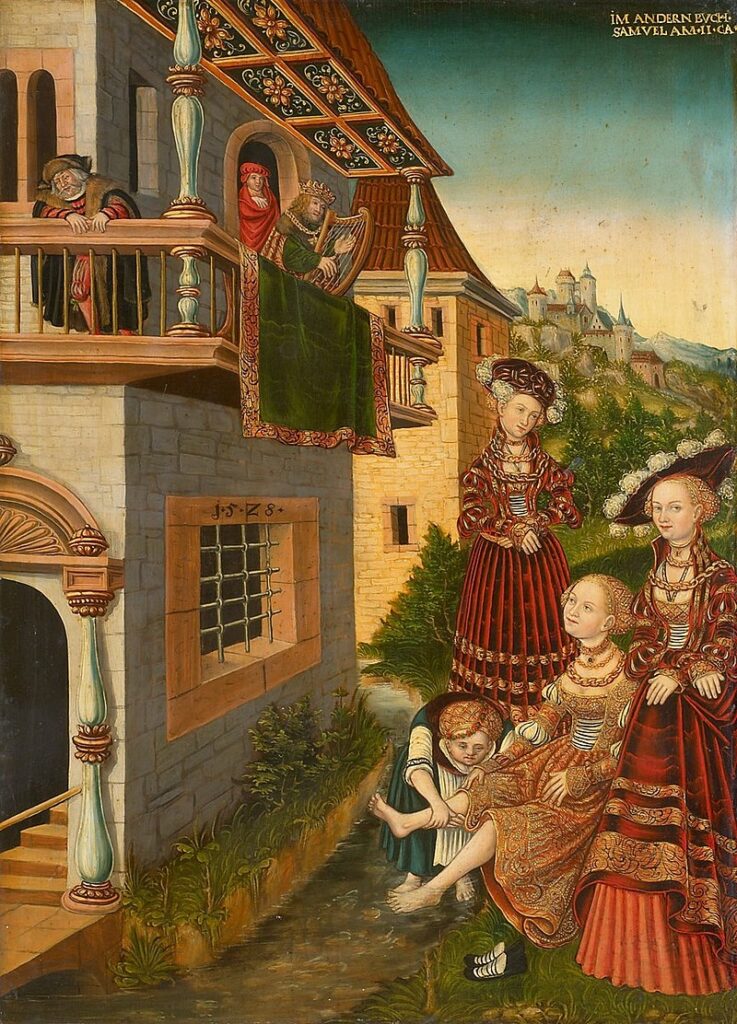
Wolfgang Krodel, Public domain, via Wikimedia Commons

THE FAITH OF BATHSHEBA
PART I

1 The book of the generation of Jesus Christ, the son of David, the son of Abraham. 2 Abraham begat Isaac; and Isaac begat Jacob; and Jacob begat Judas and his brethren; 3 And Judas begat Phares and Zara of Thamar; and Phares begat Esrom; and Esrom begat Aram; 4 And Aram begat Aminadab; and Aminadab begat Naasson; and Naasson begat Salmon; 5 And Salmon begat Booz of Rachab; and Booz begat Obed of Ruth; and Obed begat Jesse; 6 And Jesse begat David the king; and David the king begat Solomon of her that had been the wife of Urias– Matthew 1:1-6

Our text is a portion of the genealogy of Christ as recorded by Matthew.  One of the interesting features of this genealogy, especially when compared to the one given in Luke 3, is that it includes four women.  Each of these women has an interesting story to tell. 

First, and I think the most bizarre of any of them, is Tamar.  She had to trick her father-in-law Judah to fulfill the Levirate marriage custom in Genesis 38.

Second is Rahab.  She was the harlot that harbored the Jewish spies in Jericho in Joshua 2 and was spared when that city fell in Joshua 6.

Third is Ruth. She was the Moabite girl that returned home with her mother-in-law Naomi.  We have a whole book in the Bible devoted to her story.

Fourth is Bathsheba

Bathsheba’s name is not given here in Matthew’s genealogy, only that she had been the wife of Uriah and had given birth to David’s heir Solomon.  There are theories as to why she is mentioned but not by name.  I think the best one is that it was to not take away from the importance of David.  There are many great men, kings, and princes, in this list, but only David is marked as “the king.”  Another popular theory is that she is not named because of her sin, but she is far from the only sinner in this line.

The story of Bathsheba is a complex one that because of familiarity we often oversimplify.  If I were to ask you what she is famous for, I am certain everyone would say it is because of her affair with David.  It is kind of like how we talk about “Doubting Thomas” because of that one time he refused to believe that Christ had risen.  I am certain Thomas was a great man who did great things for Christ, but sadly all we remember him by is his one lapse of faith.

I want to dig deeper into Bathsheba’s story today.  I think there are some remarkable things about her that are sadly overlooked or forgotten.

But first, let us look at the basic information about who she was.  Her name is Hebrew for “daughter of the oath.”  Her father’s name was Eliam, who, if he is the same Eliam as in II Samuel 23:34, was one of David’s mighty men.  Not only that, but her grandfather, Eliam’s father, was Ahithophel, David’s chief counselor.  I think this relationship explains why Ahithophel sided with Absalom in his rebellion against David.

Bathsheba was married to Uriah the Hittite. He was also one of David’s mighty men, and according to Josephus he is Joab’s armor bearer.  He is a Hittite, which means he was not a Jew by blood but was descended from the people whose empire once covered Asia Minor.  He is certainly a proselyte to the Jewish faith.

I am going to assume you know the infamous story about Bathsheba’s affair with David. He stayed home from the war against the Ammonites and saw her bathing.  He sent for her to come to him, and they committed adultery together.  She found herself expecting David’s child. He failed to cover the sin and ended up murdering Uriah, her husband and his loyal friend and soldier.  David took her as his wife, and it all seemed to have been swept under the rug.  That is, until the day Nathan the prophet walked in and confronted David.  I can imagine the color draining from David’s face when Nathan said, “thou art the man!” 

I want to pause here and address something.  Traditionally, preachers and Bible scholars have focused their attention on David’s sin and repentance.  That is admittedly the primary narrative of Scriptures.  Some go too far in giving David a pass because they claim he was seduced by the wicked seductress Bathsheba.  This is completely wrong and goes against the clear teaching of Scripture.  David himself says in Psalm 51, the great song of repentance and restoration penned after their sin, that he is without excuse:

Against thee, thee only, have I sinned, and done this evil in thy sight:… – Psalm 51:4

More recently. there has been a tendency to make Bathsheba the victim and place all the blame on David.  This is a result of modern feminist movement and especially the “Me Too” movement.  They say David’s position made it impossible for her to refuse his advances. 

But what does the Scripture say in the matter?  According to the Mosaic Law, specifically Deuteronomy 22:22-27, both David and Bathsheba were guilty.  Bathsheba’s guilt is marked because she did not resist or cry out for help.

Both David and Bathsheba were guilty.  Both deserved the death penalty of Leviticus 20:10 for their sins.  That was the law of the land and. more importantly. the law of God.

But I am glad that there is a deeper, more foundational law found throughout Scripture: THE JUST SHALL LIVE BY FAITH.  I believe David found forgiveness through his faith and repentance.  I also believe, though it may not be as clearly stated, that Bathsheba’s faith made a change in her also as she repented of her sins and trusted in God.

This brings me to my first observation: 

By Her Faith, Bathsheba Received God’s Mercy

Remembering that the narrative focuses on David, I want you to note part of David and Nathan’s conversation.

And David said unto Nathan, I have sinned against the LORD. And Nathan said unto David, The LORD also hath put away thy sin; thou shalt not die. – II Samuel 12:13

David not only confessed his sin and repented of it, but I also think he was resigned to paying for the consequences of that sin with his own life.  That is why Nathan tells him he will not die, but that his child will.

But what about Bathsheba?  If David was guilty and deserved the death penalty, was she not also guilty?  If he was shown mercy that he did not die, was she not also shown mercy in that she continued to live?  It is obvious that she received the same mercy that David was shown.

Are you glad that God still shows mercy to us today?  You do realize that we are sinners, guilty before God, and thus deserving of an eternity in Hell?  But God shows mercy to those that repent of their sins and turn to Him for forgiveness.  We must cry out like David:

1 Have mercy upon me, O God,
according to thy lovingkindness:
according unto the multitude of thy tender mercies
blot out my transgressions.
2 Wash me throughly from mine iniquity,
and cleanse me from my sin.
3 For I acknowledge my transgressions:
and my sin is ever before me.
- Psalm 51:1-3

Have you done that?  Do you have the forgiveness of your sins?  David found it and you can too.  I believe Bathsheba found it, and as we go on, I think that will become clearer.  The mercy and grace that God showed them is still available to us today.  These freely flow to all who come to Him, whether it be to find salvation through the new birth or as His child seeking forgiveness for their shortcoming.  Hallelujah, God is merciful! 

By Her Faith, Bathsheba Grew Beyond Her Shame

People of today have no shame, but that was a big deal in the Bible world.  David and Bathsheba’s sin was a public sin. I think it had been the talk of the palace since it happened.

Can you imagine the looks Bathsheba would get?  Can you hear the whispers as she walked by?  She was married to the king, but I doubt she was treated much like a queen in those early days.

She had that public shame to endure.  She also had her own spiritual burden to bear.  On top of all that, she had the grief of losing her child.

I want you to note this wonderful phrase:

And David comforted Bathsheba his wife,… – II Samuel 12:24

He did not mistreat her, blame her for his sin, or take out his anger on her.  No, he helped her overcome her burdens.

Someone may say, “Well, you don’t know what I did. I cannot get past it.”  Friends, if Bathsheba can get past what she went through, I think God can help you get through your burdens too.  If you are breathing, God can still forgive you and use you. 

There are multitudes of people around us that are convinced that God is finished with them because of their failures.  These need someone to come along and comfort them.  We have a lot of wounded soldiers that need help and encouragement to get back in the fight.  Someone said that the Christian army is the only army in the history of the world that shoots its own wounded.  What a shame that such a statement is proven true over and over again! We need to help the wounded and weary to get back on their feet and back in the fight!

By Her Faith, Bathsheba Received a Fresh Start

In our text in Matthew, Bathsheba is described simply as “her that had been the wife of Uriah”.  That is how we are introduced to her in II Samuel:

Is not this Bathsheba, the daughter of Eliam, the wife of Uriah the Hittite? – II Samuel 11:3

That is what she is called after her husband is killed:

And when the wife of Uriah heard that Uriah her husband was dead, she mourned for her husband. – II Samuel 11:26

David of course married her in a vain attempt to cover their sin.  But after Nathan confronted David, the holy record says:

And Nathan departed unto his house. And the LORD struck the child that Uriah’s wife bare unto David, and it was very sick. – II Samuel 12:15

That child died seven days later.  I think it was sick from birth and did not reach eight days of age when it would have been circumcised and officially given a name.

But I want you to note  how Bathsheba is described next:

And David comforted Bathsheba his wife – II Samuel 12:24

A change has happened.  She is not called Uriah’s wife, but David’s wife.  She is never identified with Uriah again, except in Matthew’s genealogy.

There ought to be such a change in our lives.  We should not be tied to our past, our sins, and our failures.  A great change happened with Bathsheba’s identity, and I think that was in no small part connected to her faith and repentance.   Has your faith produced such a change in your life?  I once was a wretched sinner before God, but now I am His child and a joint heir with Christ.  Can you claim such a testimony?

By Her Faith, Bathsheba’s Children Were Blessed

…and she bare a son, and he called his name Solomon: and the LORD loved him. – II Samuel 12:24

Yes, her son is that Solomon, future king and heir of David.  We know from the genealogies in I Chronicles that she would have three more sons.  Her children are in both Matthew and Luke’s genealogies.

What a change we see!  Her first son died as judgment from God.  Her second son ruled over the golden age of Israel.  How could this be? 

Should not the firstborn son of David rule? That was Amnon, and he disqualified himself by his incestuous lust and was murdered by his half-brother Absalom. 

Should not the most popular son of David rule?  That was Absalom, and he looked the part physically but lacked David’s heart for God.  He died while attempting to seize the throne by his own power and popularity. 

Should not another wife, not marred by scandal, give birth to the next king?  David’s home life was so messy it would be difficult to find such a wife or their offspring. 

Why was Solomon divinely chosen to succeed David as king above all his siblings?  Here is my theory: it is because his parents, David and Bathsheba, had their hearts right when he was born.

How do we know Bathsheba’s heart?  We get a glimpse of it in Proverbs 31.  Most people associate this chapter with Virtuous Woman, but that really does not start until verse 10.  It is easy to skim over the opening verses and miss some important truths.  Let us look at some of them.  First note:

The words of king Lemuel,… – Proverbs 31:1

Let me ask you, who wrote the Book of Proverbs?  The simple answer is that Solomon did.  Some of it we know was compiled into its present form after his death, but essentially the work is his.

So, who is this king Lemuel?  The name means “consecrated to God.”  I believe, like many conservative Bible scholars, that this is a nickname or a pen name for Solomon.

We continue and note:

…the prophecy that his mother taught him. – Proverbs 31:1 

If Lemuel is Solomon, then his mother would be… BATHSHEBA!  So, what we have in verses 2 through 9 are the lessons she gave her son to prepare him to rule.  I can briefly summarize them as be careful with women, do not be fooled by wine, and make sure to be a faithful and fair judge.  These are not just more of Solomon’s proverbs; they are the lessons that his mother Bathsheba faithfully taught the young crown prince from his youth.

Now, I have another question for you:  who is the Virtuous Woman in the rest of the chapter 31?  Is this also Bathsheba’s advice to her son? Could this perhaps be Solomon’s restructuring of his mother’s teaching into a poem?  Could it be that Solomon is looking at his own mother as an example of an ideal woman?  I cannot say for sure, but I am partial to that last idea.  I think there is a very good chance that the Virtuous Woman is Bathsheba.  If they are not the same, it is certain that Bethsheba’s character or teaching influenced Solomon’s vision of the ideal woman.

Closing Remarks

As we close, I want to note how Proverbs 31 closes describing the Virtuous Woman. I see here reflections of Bathsheba that are a challenge for us today.

30  Favour is deceitful, and beauty is vain:
but a woman that feareth the LORD, she shall be praised.
31  Give her of the fruit of her hands;
and let her own works praise her in the gates.
– Proverbs 31:30-31

First, note “a woman that feareth the LORD.”  Do you have a proper view of the greatness of God and the smallness of yourself?  Does you life reflect it?

Second, not “she shall be praised.”  Allow God to raise you up and bless you.  He did so with Bathsheba, raising her from being an adulterer to being a queen.  This was certainly God’s hand at work and not her own schemes or machinations

Third, “let her own works praise her in the gates.”  Bathsheba had a testimony and track record.  What is yours like today?  Are you a person of faith?  Most importantly, do you have saving faith?

Unknown 18th-century artist; photographed by Hermetiker, Public domain, via Wikimedia Commons

The Faith of Bathsheba
Part II

I was very interested to see the response from the last sermon before I committed to continuing the topic with a second sermon.  I asked at the end of the previous service if anyone had ever heard a positive message about Bathsheba, and only one person raised their hand.  I am not trying to be controversial nor  am I trying to find something new in Scripture.  I have tried to vet all my conclusions through commentaries and authors I trust.  If I have done anything, I hope that I have at least caused some people to think and check things out for themselves.

Most of what I have said and will say is just compiling different facts into one framework.  Kind of like a mosaic, where you take little rocks or tiles and place them together to create a picture.  There is so much to Bathsheba’s story than just her affair with David.  I am afraid our prejudices have kept us from seeing a beautiful story of faith and redemption in the other pieces of her life.

The points we looked at last time I think are foundational for what we will look at today.  In some ways, I think we see the events in the previous sermon as either her salvation or her repentance that brought righteousness into her heart and life.  It could be that she did not have true faith in God until David helped lead her to it.  It could also be, and I think it is the case, that she had faith but fell in sin and had to be brought back through repentance.

Quickly, let us review her life and our observations last week.  Bathsheba was the wife of Uriah, one of David’s mighty men.  He father was Eliam, another of David’s mighty men.  Her grandfather was Ahithophel, David’s chief advisor.  She and David committed adultery together.  Both sinned and both were guilty before God and man.  David tried to cover the sin and ended up murdering Uriah so that he could himself marry Bathsheba.  Their scheme seems to have worked until Nathan the prophet confronted David.  David confessed his sin and repented.  We have evidence of this repentance in Psalm 51 and Psalm 32.  B.H. Carroll said that “if Psalm 51 is the highest expression of penitence, Psalm 32 is the model expression of the joy of forgiveness.”

By her faith, Bathsheba received God’s mercy  We looked at II Samuel 12:24  and how David comforted Bathsheba, convincing her not only of her place being safe with him, but also with God.

By her faith, Bathsheba grew beyond her shame.  She was no longer called the “wife of Uriah”, but now the “wife of David.”

By faith, Bathsheba received a fresh start. “She bare a son” and named him Solomon.  I am convinced that he was marked as David’s successor from birth.

By faith, Bathsheba’s children were blessed.  We saw how in Proverbs 31, that Bathsheba faithfully instructed and trained Solomon.

We saw in these things that through faith Bathsheba repented, overcame her sin, found forgiveness in God, and changed the course of not only her life and but also those of her children.

We will here examine more examples of her faith bearing fruit.  We will pick back up her story after the birth of Solomon:

By Her Faith, She Refused to Carry a Grudge

For this point, I want to examine Bathsheba’s relationship with the prophet Nathan.  Their first interaction that we know of is when he was confronting David and said that Bathsheba’s child would die.

13 And David said unto Nathan, I have sinned against the LORD. And Nathan said unto David, The LORD also hath put away thy sin; thou shalt not die. 14 Howbeit, because by this deed thou hast given great occasion to the enemies of the LORD to blaspheme, the child also that is born unto thee shall surely die. – II Samuel 12:13-14

A few days later, Bathsheba’s newborn son was dead.  I do not know about you, but I do not think I would invite someone who told me my first baby would die to the baby shower for my second baby.  I doubt I would want to see someone ever again that had proclaimed such a thing. 

But what do we find about a year or so later?  We see:

24…and she bare a son, and he called his name Solomon: and the LORD loved him. 25 And he sent by the hand of Nathan the prophet; and he called his name Jedidiah, because of the LORD. – II Samuel 12:24-25

Here is Nathan again with a message about Bathsheba’s newborn son.  But this message was quite different from the previous.  He blessed this child by giving him the name Jedidiah, meaning “Beloved of Jehovah”.  This is the second interaction between the two, and obviously more positive than the first.

But these are not the only connections between Bathsheba and Nathan.  There is a third interaction almost twenty years later in I Kings 1.  David was sixty-nine years old and in rapidly failing health.  His oldest surviving son, Adonijah, tried to seize the throne by proclaiming himself as David’s successor.  Nathan and Bathsheba had to work together to counter this coup and ensure Solomon inherited the throne as David had planned.

11 Wherefore Nathan spake unto Bathsheba the mother of Solomon, saying, Hast thou not heard that Adonijah the son of Haggith doth reign, and David our lord knoweth it not? 12 Now therefore come, let me, I pray thee, give thee counsel, that thou mayest save thine own life, and the life of thy son Solomon. – I Kings 1:11-12

We will come back to that story in just a bit, but for now note that Bathsheba and Nathan see each other as trusted allies.  That is quite a roller coaster ride of a relationship!  Again, I do not think if I had gone through the trauma of losing a child, like Bathsheba did, that I would want anything to do with the man who prophesied of their death.  Yet here they are working and trusting each other in a critical time.

There is one more element to their relationship that I find astounding.  David and Bathsheba would have more children after Solomon.  You find a list of sons  in I Chronicles 3, which you may overlook because Bathsheba’s name is spelled differently in the passage.

And these were born unto him in Jerusalem; Shimea, and Shobab, and Nathan, and Solomon, four, of Bathshua [alternate spelling of Bathsheba] the daughter of Ammiel: – I Chronicles 3:5 

Did you catch those names?  Shimea, Shobab, Solomon, and Nathan.  Yes, one of David and Bathsheba’s sons was named after the man who publicly rebuked their sin.  That is not something a human being does in their human reasoning, but rather it is evidence of a Divine change of their character.

Have you ever tried to help someone, perhaps to have a difficult conversation with them that needed to take place, and then have them turn on you?  That is human nature.  Often, we fail to understand that someone can act in love and yet it still hurts.  I think Bathsheba and David both came to understand that Nathan was acting out of love when he confronted them about their sins.  This lesson must have been passed down to Solomon, who wrote:

Faithful are the wounds of a friend; but the kisses of an enemy are deceitful. – Proverbs 27:6 

If this were the only evidence I had of Bathsheba’s life after her sin with David, it would be enough to satisfy me that her faith in God had truly made a change in her life.  Christ said in the Sermon on the Mount in Matthew 7 that you truly know someone by the fruit they bear.  Do we have such beautiful fruit in our actions as we see here in Bathsheba’s?

By Her Faith, She Fought for What was Right.

As we just observed, there was a succession crisis in the final year of David’s reign.  Adonijah tried to claim the throne, but David had already appointed Solomon as his rightful heir.  The prophet Nathan came to Bathsheba to ask for her aid.

What follows reminds me of the Book of Esther.  In both cases a queen had to approach a king to stop great evil.  In both cases the history of Israel hinged on if the queen’s appeal worked.

Bathsheba went before the bedridden David.  She did not approach him as a wife, but as a humble subject:

15 And Bathsheba went in unto the king into the chamber: and the king was very old; and Abishag the Shunammite ministered unto the king. 16 And Bathsheba bowed, and did obeisance unto the king. And the king said, What wouldest thou? – I Kings 1:15-16

She was not there to force her own will on the king, but to make him acknowledge and enforce his own.  She reminded him of his promise that Solomon would be king.  She informed him of Adonijah’s traitorous actions.  She reminded him that if he did not intercede that both she and Solomon would surely be killed.

Nathan entered to give the same report and Bathsheba exited.  In response to Nathan and Bathsheba’s interventions, David was moved to action:

28 Then king David answered and said, Call me Bathsheba. And she came into the king’s presence, and stood before the king. 29 And the king sware, and said, As the LORD liveth, that hath redeemed my soul out of all distress, 30 Even as I sware unto thee by the LORD God of Israel, saying, Assuredly Solomon thy son shall reign after me, and he shall sit upon my throne in my stead; even so will I certainly do this day. 31 Then Bathsheba bowed with her face to the earth, and did reverence to the king, and said, Let my lord king David live for ever. – I Kings 1:28-31

Just in passing, note her response: “Let my lord king David live for ever.”  This is genuine love for her husband and sovereign.  She would rather have David live on than have her son on the throne.  This is further proof to me that she is not being manipulative here.  No, she is standing for what is right.

I am convinced that David, Nathan, and Bathsheba knew that it was God’s will for Solomon to be the heir since his birth or even before.  I am convinced they knew that the great Davidic Covenant of II Samuel 7 would continue through Solomon.  In the moment of crisis, Bathsheba and Nathan stepped in to ensure that right was done.

Is there any greater expression of faith than to take a stand when all seems lost?  Moses proved his faith in God when he was backed up to the Red Sea.  Daniel proved his faith when he was cast in the lion’s den.  What about us?  What are we standing for? What will we lay down our lives for?  I have a short list of things I pray I am strong enough to die for: my faith, my family, my country.  How sad it is to see those who claim to be Christians melt away when adversity comes!

By Her Faith, She was Honored at the End

There is one last story we will look at involving Bathsheba and it is in I Kings 2.  David had died and Solomon reigned alone over Israel.  Adonijah had been forgiven by Solomon for attempting to take the throne before David’s death, but he had not given up on his schemes.

In I Kings 2:13, Adonijah came to Bathsheba with a request to marry David’s wife/caretaker Abishag.  He must have laid some kind of sob story on Bathsheba, who failed to see the machinations behind the request.  This is not the focus of this point, but here I think Bathsheba is being kind to a fault.  If anything, she seems more endearing to me for trusting this man too much.  Bathsheba agreed to relay the request to king Solomon, who of course saw through the ploy and had Adonijah executed along with other conspirators.

What I want us to focus on is the way Solomon honored his mother.  I am going to dissect I Kings 2:19 because there is so much to see in it.

Bathsheba therefore went unto king Solomon, to speak unto him for Adonijah. And the king rose up to meet her,…

Kings passively accept homage from others, yet here he actively gave honor to his mother.

…and bowed himself unto her,…

He humbled himself and exalted his mother.  The Hebrew word here is shachah which is a root word for worship.

…and sat down on his throne, and caused a seat to be set for the king’s mother;…

He honored her with a throne to sit upon

…and she sat on his right hand.

This is the place of honor.  The right hand of the king is the most exalted place he could offer someone.

I think this event set a precedent for honoring the queen mother.  We see this practice alluded to in I Kings 15:13, II Kings 11:1-3, and 24:15.  We should also note here how the name of the mother is highlighted for all the succeeding kings, whereas there is no record in Scripture of the names of either Saul or David’s mothers.  Solomon certainly started a trend!

I am reminded of these verses:

6 For promotion cometh neither from the east,
nor from the west, nor from the south.
7 But God is the judge:
he putteth down one, and setteth up another.

– Psalm 75:6-7

Bathsheba, the unfaithful wife, forgiven by God, transformed by faith, is now the queen mother.  Remarkable, is it not?  This was accomplished not through her own power or strength.  This was not through her plots or schemes.  Friends, there is only one answer for how Bathsheba grows from II Samuel 11 to I Kings 2.  It is the grace of God.

Did she deserve the honor?  By our human opinion she did not.  I believe God honored her faith and her repentance to exalt her, using her to bring Solomon into this world.

The question I would ask is: do we deserve what we have in our lives?  Do we deserve to be children of God?  Do we deserve such a fine church family?  No, God has surely poured out His grace on us!  What He seeks in us is faith:

But without faith it is impossible to please him: for he that cometh to God must believe that he is, and that he is a rewarder of them that diligently seek him. – Hebrews 11:6 

I am convinced that it is faith in God that transformed Bathsheba’s life and that still transformed lives today.

Closing Remarks

I am afraid that we have let our prejudices against Bathsheba and her sin with David rob us of a beautiful story of redemption.  She overcame that sin, was greatly used by God as a mother and queen.  She became a vital part of Jewish history.  If God can do that with her, I guarantee you can do great things with you.

God can surely transform the vilest sinner into the holiest saint.  There is a famous story about a lawyer in the Deep South after the Civil War.  He had a promising career ahead of him but fell victim to the temptations of alcohol.  His fine suits were turned to rags.  His eloquence turned to stammering.  But God had other plans.  He grabbed hold of the heart of that drunken lawyer.  He became a preacher and a Methodist circuit rider.  Doors continued to open for him and his audiences grew in size. New and larger auditoriums had to be built to house the throngs that wanted to hear him, including the famous Ryman Auditorium in Nashville, Tennessee.  Who was that drunken lawyer turned preacher?  His name was Sam Jones.  While D.L. Moody shook the northern states for Christ, Sam Jones shook the south.  Thousands upon thousands found Christ through his preaching.                                                                       

Have you found forgiveness and redemption in Christ?  I do not care how great a sinner you claim to be.  No one is beyond God’s grace and forgiveness.  Come back to Him today!  He will not turn you away!  He can still use you for His glory!

Was Ahaziah 22 or 42 When He Became King?

Two and twenty years old was Ahaziah when he began to reign; and he reigned one year in Jerusalem. And his mother’s name was Athaliah, the daughter of Omri king of Israel.” – II Kings 8:26

Forty and two years old was Ahaziah when he began to reign, and he reigned one year in Jerusalem. His mother’s name also was Athaliah the daughter of Omri.” – II Chronicles 22:2

First, it must be stated that this is not a KJV issue, it is a Hebrew text issue.  The Hebrew Masoretic text in II Kings 8:26 says twenty-two years and in II Chronicles 22:2 says forty-two years. To deny the forty-two years in I Chronicles is to deny the text and imagine a mistake was made.

There are other ancient translations that appear to have “corrected” the 42 to 22, including the Septuagint.  I do not think this is evidence for an error, but rather that many before were like the critics of today and sought to “correct” perceived errors. 

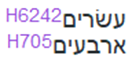
Second, it is frankly improbable that this is a copyist’s mistake.  Below is an illustration of the mistake that is imagined having been made by a uncareful scribe. [1]  The top word is “twenty” and the bottom is “forty”.  This would not have been a simple mistake, like making an “O” a “Q”.

Third, there are many misrepresentations of the facts by those who claim there is a copyist mistake here.  For instance, it is often stated that these numbers are reckoned using numerical letter values.  Thus כ (kaf ­= 20) and  מ (mem = 40) are mistaken for each other.  But the text is not using this system and instead spells out the words as seen above.

Another instance is an insistence that Ahaziah’s father Jehoram died at the age of 40, those making it impossible for Ahaziah to ascend the throne at age 42.  However, the text never explicitly states how old Jehoram was when he died.  It states that Jehoram was 32 when began to reign and reigned for 8 years “in Jerusalem” (II Kings 8:17, II Chronicles 21:5&20).  It is therefore assumed that those 8 years begin when he is 32, but that does not have to be the case if there was a coregency between Jehoram and Jehoshaphat before an 8-year solo rule.

Fourth, while I cannot find one conclusive solution to this conundrum, there are multiple theories that are quite plausible.

Matthew Poole notes two possible solutions based on the idiomatic language found in II Chronicles 22:2, these being either the 42 years as the age of Ahaziah’s mother Athaliah or the age of Omri’s dynasty:

“In the Hebrew it is, a son of forty-two years, &c., which is an ambiguous phrase; and though it doth for the most part, yet it doth not always, signify the age of the person, as is manifest from 1 Samuel 13:1, See Poole ‘1 Samuel 13:1’. And therefore it is not necessary that this should note his age (as it is generally presumed to do, and that is the only ground of the difficulty); but it may note either,
“1. The age of his mother Athaliah; who being so great, and infamous, and mischievous a person to the kingdom and royal family of Judah, it is not strange if her age be here described, especially seeing she herself did for a season sway this sceptre. Or rather,
“2. Of the reign of that royal race and family from which by his mother he was descended, to wit, of the house of Omri, who reigned six years, 1 Kings 16:23; Ahab his son reigned twenty-two years, 1 Kings 16:29; Ahaziah his son two years, 1 Kings 22:51; Joram his son twelve years, 2 Kings 3:1; all which, put together, make up exactly these forty-two years; for Ahaziah began his reign in Joram’s twelfth year, 2 Kings 8:25. And such a kind of computation of the years, not of the king’s person, but of his reign or kingdom, we had before, 2 Chronicles 16:1, See Poole ‘2 Chronicles 16:1’. And so we have an account of the person’s age in 2 Kings 8:26, and here of the kingdom to which he belonged.”[2]

The Trinitarian Bible Society has published a solution involving coregencies:

“Again, a number of scholars attribute the apparent discrepancy to a copyist’s error. We are unwilling to do this, particularly as this discrepancy can be reconciled. The Hebrew Masoretic Text has ‘forty-two’ in 2 Chronicles 22.2; and while only the original manuscript was ‘inspired’, God has, in His special providence, preserved the Holy Scriptures so that we do now possess faithful and authoritative copies.
“We must admit, of course, that there is a problem in reconciling these two Scriptures. In 2 Kings 8.17, we are told that Jehoram (Ahaziah’s father) was thirty-two when he became king, and that he died eight years later, apparently at the age of forty. Now if Jehoram was eighteen years old when he became a father, this would mean that Ahaziah would have been twenty-two years old when he succeeded his father on the throne of Judah. And that is what the inspired historian says in 2 Kings 8.26. But 2 Chronicles 22.2 states that Ahaziah was forty-two years old when he became king. If Jehoram died at forty and Ahaziah became king at forty-two, then Ahaziah appears to have been two years older than his father!
“There have been various explanations, but we will confine ourselves to just one of these. According to 2 Kings 8.17, Jehoram (the father) was thirty-two when he began to reign. This appears to have been as co-regent with Jehoshaphat, for note the wording of 8.16, ‘Jehoshaphat being then king of Judah, Jehoram the son of Jehoshaphat king of Judah began to reign’. If Jehoram, at thirty-two, was co-regent with Jehoshaphat for twenty years, and then sole monarch for another eight years – and Scripture says that ‘he reigned eight years in Jerusalem’ (8.17) – this would mean that he died at the age of sixty (and not forty).
“Now this brings us to Ahaziah. Let us suppose that he was admitted to co-regency when he was twenty-two years old (as in 2 Kings 8.26) and that he continued in his office as co-regent for twenty years, he would then have begun to reign alone in his father’s sixtieth year, when he himself was forty-two years old – exactly as we have it stated in 2 Chronicles 22.2.
“Co-regency was a common practice in Israel ever since the time of David, who used it to ensure the succession of Solomon (1 Kings 1.29ff). If we take it into account here, we are able satisfactorily to harmonize 2 Kings 8.26 and 2 Chronicles 22.2.
“The explanation given above upholds the Masoretic Text and is perfectly reasonable. The believer in verbal inspiration always takes the position of faith: that is, he always tries to find an answer to a problem posed by the text of Holy Scripture. The believer does not immediately – or indeed after study – jump to the conclusion that there is an error in the text. Instead, he believes there is an answer to all these problems, even if he does not know the answer at that particular time. ‘The scripture cannot be broken’ (John 10.35).”[3]

There is another, to me, less plausible theory that Ahaziah was not the actual son of Jehoram, but his stepson.  This theory involves Athaliah being the daughter of Omri and not Ahab, and that Ahaziah was born to another husband before her marriage to Jehoram.  This would account for the idea that he is older than his father, if Jehoram did indeed die at 40 and Ahaziah became king at 42.  I do not think this is the best interpretation of all the Scriptural evidence.

Fifth, there are deep and convoluted ties between the Northern and Southern Kingdoms at this time that may not be possible to completely unravel.  Evidence for this includes:

  • In II Chronicles 18:1, it is noted that Jehoshaphat (Judah) enters an “affinity” with Ahab (Israel).  This involves a marriage between Jehoshaphat’s son Jehoram and Ahab’s daughter Athaliah.  This does not unite the kingdoms, but it does intertwine the ruling houses.
  • In II Chronicles 20:35, Jehoshaphat is said to “join himself with Ahaziah king of Israel” (Ahab’s son).  The nature of this arrangement is not clear except for a trading venture at Ezeiongeber.
  • In II Chronicles 21:2, Jehoshaphat is said to be “king of Israel”.  This is often taken as another “copyist’s error” but could use Israel generically for the Jewish people[4] or could be used literally of the Northern Kingdom. That latter option could reflect the alliance between the kingdoms.
  • In II Kings 8:27, Ahaziah is said to be the “the son in law of the house of Ahab”.  Poole comments: “He was the proper son of Athaliah, daughter of Ahab, and the grandson-in-law of Ahab, because his father was Ahab’s son-in-law”.[5]  Most do not believe that he married someone of Ahab’s house, but that his relation was the son of his son-in-law.  The one wife we are aware of is Zibiah (II Chronicles 24:1) but it is possible there could be more, perhaps even a daughter of Ahab.
  • In I Kings 22:6, a “king’s son” named Joash is mentioned that some a few[6] is the same as Joash, king of Judah.  The chronology does not seem to support this and most commentators state this is a different Joash.[7]  This is a possible link, but I very doubtful.

These deep ties could make chronology difficult if, for instance, a prince was raised over a different kingdom for a time until they became king of another kingdom.


MY THEORY

I believe that both of Ahaziah’s ages are correct but refer to different occasions of becoming a prince or king.  He became a prince or co-ruler at 22 and then sole king at 42.

This theory depends on coregencies going back to at least into the reigns of Asa or Jehoshaphat.  Let us look at the evidence from the reigns of the kings of Judah dating back to Rehoboam.  Note the ages of when the heirs became king and lengths of their reigns.

  • Rehoboam was 41 years old when he became king and reigned 17 years (I Kings 14:21, II Chronicles 12:13).
  • Abijah/Abijam was 34 years old[8] when he became king and reigned 3 years (I Kings 15:1-2, II Chronicles 13:1-2).
  • Asa was 18 years old[9] when he became king and reigned 41 years (I Kings 15:9-11, II Chronicles 16:13-14)
  • Jehoshaphat was 35 years old[10] when he became king and reigned 25 years (I Kings 22:41-42, II Chronicles 20:21)
  • Jehoram was 32 years old[11] when he became king and reigned eight years (I Kings 22:17,20; II Chronicles 21:5).
    • There is definitely a coregency between Jehoshaphat and Jehoram (II Kings 8:16).  Reese says this is for 5 years on top of the 8 years, making 13 years total.

The coregency of Jehoram is key.  It is unclear if the 8-year reign includes the coregency or not.  This falls into the vagaries of chronological studies.  I have found differing opinions on the matter. My theory is that it does not and those 8 years are the length of his reign as king.

So, is there a gap between Jehoram becoming coregent with his father and his solo reign of eight years?  I believe there is.  Gill quotes Lightfoot saying that there are possibly three ways to calculate the beginning of his reign:

“…according to Dr. Lightfoot, there were three beginnings of his reign; ‘first’, when his father went with Ahab to Ramothgilead, when he was left viceroy, and afterwards his father reassumed the kingdom; the ‘second’ time was, when Jehoshaphat went with the kings of Israel and Edom against Moab; and this is the time here respected, which was in the fifth of Joram king of Israel; and the ‘third’ time was, at the death of his father; but knew his father was living.”[12]

Interestingly, according to Reese’s chronology, this is roughly the same time (~898 B.C.) the Ahab entering a coregency with his son Ahaziah.[13]  This all seems to involve the combined campaign of Jehoshaphat and Ahab against Syria.  There is a likelihood that these coregencies were safeguards in case the coming military campaign went bad.

The ages of Jehoshphat and Jehoram at the beginnings of their reigns suggest that that their presumptive heirs were born around the time of their ascensions. Then when the heirs were of a respectable age, they were given some authority, perhaps as a secondary ruler or even coruler.  Such a thing is not unknown in history.  Diocletian would do something similar with the Roman Empire with the establishment of the Tetrarchy in the late third century.

If these assumptions are true, then it is likely that Jehoram is older than Reese’s calculations.  He would have been born when Jehoshaphat was perhaps 18-20 years old.  He would have been given some authority or title (up to coregency) when he was also around 18-20 years old.  This shows he could very well have been elevated to a prince or coregent for most around 20 years of Jehoshaphat’s reign before being the primary ruler for eight years.  This scenario allows Jehoram to have a son very early in his father’s reign.  This son, Ahaziah, would then follow a similar track, being elevated in his late teens (or perhaps even as an infant or child) to be a prince or coregent.  This could feasibly even date back into his grandfather’s reign.

So, it is both possible that Ahaziah became a ruler (prince/coregent) at the age of 22 but the primary ruler (king) at 42.  He had twenty years of ruling experience of some lesser type before his ascension to the throne.

Why then does II Chronicles, written after the Babylonian Captivity, give a different age?  There are numerous examples where Chronicles has a different approach to numbers than Samuel/Kings.  It is commonly theorized that Chronicles was written with access to different sources of information than Samuel/Kings, perhaps even different official records.  I think there is also a perspective shift on how some things were calculated that comes from Babylonian and Persian influences.  In many cases, I believe the changes where Chronicles varies information in Samuel/Kings are to clarify something that now was confusing with this perspective shift in place.

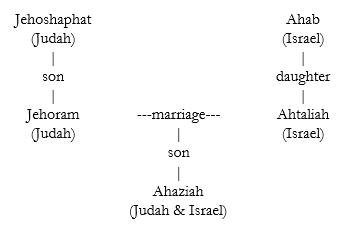
The answer to why the writer of Chronicles chose to record the age differently is because of the Ahaziah’s ties to the Northern Kingdom and the house of Omri and Ahab.  Chronicles focuses on the Southern Kingdom, not the Northern.  Ahaziah is technically a prince of both Kingdoms. Note his genealogy:

Therefore, in Ahaziah we find an opportunity for the Kingdoms to be united again.  The problem with this would be that idolatrous influence of the counterfeit religion of Jeroboam and the corrupted religion of Jezebel that seems to have had a great influence on Ahaziah.  It is noted that Ahaziah “walked in the ways of the house of Ahab: for his mother was his counsellor to do wickedly.” (II Chronicles 22:3).  God intervenes and ends these evil influences with Jehu’s rise in the Northern Kingdom, followed by the execution of Athaliah and the ascension of Joash in the Southern Kingdom.  It likely speaks to the wickedness of Ahaziah that he is cut down by Jehu in his purge of Ahab’s house.

On this it is worth noting how Matthew’s genealogy of Christ handles this series of kings: “And Asa begat Josaphat; and Josaphat begat Joram; and Joram begat Ozias [a.k.a., Uzziah or Azariah];” (Matthew 1:8).  Matthew skips Ahaziah, Joash, and Amaziah.  Gill comments: “either because of the curse denounced on Ahab’s family, into which Joram married, whose idolatry was punished to the third or fourth generation; or because these were princes of no good character; or because their names were not in the Jewish registers.”[14]  It is plausible to assume that the writer of Chronicles and Matthew have a similar approach to approaching the influence of Ahab, that is, ignoring it.

To summarize my theory:  Ahaziah was 22 years old when he became a prince/coregent, possibly with connections to the Northern Kingdom.  Ahaziah was 42 years old when he became king of Judah.  The writer of II Kings chose to include the time as prince/coregent, and the writer of II Chronicles did not.

In my opinion, the burden of proof should lie on those that claim there is an error in the text.  They can prove others believed there was an error and that attempts were made to correct this perceived error, but not that there is an actual error.  It is merely theorized that there is an error in the text to account for something that does not seem to make sense.  The danger here is that because something does not make sense to someone, it is assumed that it is because there is an error.  This makes man the final arbiter between what is God-breathed Scripture and what is not.  To casually dismiss something as an error when there are multiple plausible scenarios for it to be correct is careless as best.


[1] Made with screenshots from E-sword module “Hebrew Old Testament (Tanach) w/ Strong’s Numbers”.

[2] https://biblehub.com/commentaries/poole/2_chronicles/22.htm – accessed 10-13-23

[3] “Brief notes on 2 Samuel 15.7, 2 Kings 8.26 and 2 Chronicles 22.2” by the Rev. M. H. Watts from the Trinitarian Bible Society’s April-June 2004 Quarterly Record. Found at: https://cdn.ymaws.com/www.tbsbibles.org/resource/collection/156A9AA2-2086-4C4E-BE0A-08A4508415DA/Brief-Notes-2-Samuel-2-Kings-2-Chronicles.pdf – accessed 10-13-23

[4] So says Ellicott’s Commentary for English Readers on this passage.

[5] Matthew Poole’s Commentary, E-Sword module.

[6] Ruckman, for example.

[7] Reese, Gill, and Barnes are examples.

[8] Reese estimates that Rehoboam was 24 at his son’s birth.

[9] Reese estimate that Abijam was 19 at his son’s birth.

[10] Reese estimates that Asa was 24 at his son’s birth.

[11] Reese estimates that Jehoshaphat was 25 at his son’s birth.

[12] Gill’s Commentary on II Kings 8:16 – E-sword module.

[13] Reese’s Chronological Study Bible, p. 624.

[14] Gill’s Commentary, E-Sword Module

Physical Expression in Worship

There has been great debate throughout the history of Christianity on how to properly and acceptably express worship through physical expression. The debate is usually presented as a false dichotomy: you are either for physical expression in worship or you are not. Actually, there is a vast spectrum of opinions on the matter.

Photo by James Coleman on Unsplash

If we were to be honest, how we express our worship to God has much to do with our culture. Some cultures are far more physically expressive than others and it tends to bleed into how they worship. This is evident here in America, where many have observed that church services in the south are typically livelier than those in the north. A church service in Central America may be even livelier, while one in Europe may not be lively at all. Each of these situations is caused by the culture of the people.

Culture is something that must be considered when discussing this topic. Our modern American culture has some overlap with that of ancient Israel but there are also great differences. For instance, we do not express lament or mourning by tearing our clothes, wearing sackcloth, and putting ashes on our heads (II Samuel 13:19, Esther 4:1, Daniel 9:3, Jonah 3:6, etc.). Yet we know what these actions represent in that culture.

The bottom line is that physical expression is worship is an area of Christian liberty. There are many verses that condone it and few that condemn it. As Paul said in Romans 14:5: “Let every man be fully persuaded in his own mind.”

The issue today is that there is a great push for physical expression in worship that is not based on sound interpretation of Scripture. In this chapter, I want to look at four commonly promoted physical expressions and examine the Biblical case for each.

Bowing/Kneeling/Prostration

The primary Hebrew and Greek words used for worship carry with them the idea of bowing or prostration. The Hebrew shachah (Strong’s H7812) is defined as:

“A primitive root; to depress, that is, prostrate (especially reflexively in homage to royalty or God): – bow (self) down, crouch, fall down (flat), humbly beseech, do (make) obeisance, do reverence, make to stoop, worship.”

The Greek proskeneo (Strong’s G4352) is defined as:

“to fawn or crouch to, that is, (literally or figuratively) prostrate oneself in homage (do reverence to, adore): – worship.”

So obviously there is a connection between worshipping and humbling oneself by lowering ourselves toward the ground. I do not think anyone would deny that.

The issue then is whether that physical expression is figurative or literal for us today. Can this be done?

We must consider that in Hebrew especially there is a tendency to express abstract concepts with concrete imagery. That is, things that cannot be interacted with via our human senses are explained with things that are. A great example of this is the word qavah (Strong’s H6960) which is translated as “wait” in Isaiah 40:31. The Strong’s definition for this word is:

“to bind together (perhaps by twisting), that is, collect; (figuratively) to expect: – gather (together), look, patiently, tarry, wait (for, on, upon).”

Thus, the abstract idea of waiting is expressed in the concrete imagery of twisting and binding, such as braiding a rope from individual fibers. We see this meaning in Genesis 1:9 and Jeremiah 1:17 where qavah is translated “gathered”.

Does “waiting” (qavah) on the Lord mean that I must be twisting and binding? I do not think anyone would take those implied actions as literal. Instead, we would enhance our understanding of “waiting” to include preparing, strengthening, or producing so that waiting does not mean idleness.

So, does “worshipping” (shachah) mean that I must bow myself to the earth to truly worship? I would contend that it is a similar case to that of qavah, in that the implied action should be applied figuratively. It is therefore important to humble ourselves before God in our spirit, which may or may not be expressed physically.

Let me be honest here. I do not see any sort of command or precedent for physically bowing in our worship today. But of all the physical expressions we will discuss, this is the one that I would have the least problem with because it is the truest to the original sense of the words. Personally, I often lay prostrate on the ground in private prayer. I do think it would be out of place in corporate worship.

Clapping Hands

Clapping hands is a sign of joy or appreciation in our American culture. We may clap when our sports team wins or after a piano recital.

There is a little more nuance to the action when it appears in the Bible. It is chiefly an expression of joy or appreciation. However, it is also used in a mocking or derisive sense. Let’s look at the appearance of clapping and what each represents.

The first group are verses in which clapping hands is a clear expression of joy:

“And he brought forth the king’s son, and put the crown upon him, and gave him the testimony; and they made him king, and anointed him; and they clapped their hands, and said, God save the king.” – II Kings 11:12

“O clap your hands, all ye people; shout unto God with the voice of triumph.” – Psalm 47:1

The second group are verses in which anthropomorphic rivers and trees clap their hands in joy:

“Let the floods clap their hands: let the hills be joyful together” – Psalm 98:8

“For ye shall go out with joy, and be led forth with peace: the mountains and the hills shall break forth before you into singing, and all the trees of the field shall clap their hands.” – Isaiah 55:12

The third group are verses in which clapping hands is derisive or mocking, like gloating over a defeated enemy:

“Men shall clap their hands at him [wicked man], and shall hiss him out of his place.” – Job 27:23

“For he [Job] addeth rebellion unto his sin, he clappeth his hands among us, and multiplieth his words against God.” – Job 34:37

“All that pass by clap their hands at thee; they hiss and wag their head at the daughter of Jerusalem, saying, Is this the city that men call The perfection of beauty, The joy of the whole earth?” – Lamentations 2:15

“For thus saith the Lord GOD; Because thou [Ammon] hast clapped thine hands, and stamped with the feet, and rejoiced in heart with all thy despite against the land of Israel; Behold, therefore I will stretch out mine hand upon thee, and will deliver thee for a spoil to the heathen; and I will cut thee off from the people, and I will cause thee to perish out of the countries: I will destroy thee; and thou shalt know that I am the LORD.” – Ezekiel 25:6-7

“There is no healing of thy [Assyria’s] bruise; thy wound is grievous: all that hear the bruit of thee shall clap the hands over thee: for upon whom hath not thy wickedness passed continually?” – Nahum 3:19

Those nine references are all the references to clapping in the Bible. None of the five references in the third group are instructive for us as they do not relate to worship. Neither does II Kings 11:12. I would say that both Psalm 98:8 and Isaiah 55:2 are artistic representations of joy and not instructive to us.

This leaves us with one verse – Psalm 47:1 – to build a case for clapping our hands in worship of God. Here I believe we see the joyful praise of the Messiah in His Kingdom (see vs. 7-9) expressed through clapping (applause), shouting (vs. 1), and singing (vs. 6-7). Charles Spurgeon wrote: “The most natural and most enthusiastic tokens of exultation are to be used in view of the victories of the Lord, and his universal reign. Our joy in God may be demonstrative, and yet he will not censure it.”

I do believe that clapping is an acceptable means of expressing our joy toward God. I do think this refers to applause and not keeping rhythm to a song.

Raising Hands

Over the past few decades, the act of raising hands has become an almost ubiquitous expression of worship. Even in conservative churches there is often a grudging acceptance of the act even if it is not actually promoted or practiced.

I believe there is a great misunderstanding on the subject that is based on people reading a different definition or motivation into the appearance of raising hands in the Bible. To try to avoid confusion, we will look at the references to the practice grouped according to what the act of raising hands is referring to. I do acknowledge that some of these could fit into different or even multiple categories.

First, there is a group of references where raising hands is part of pronouncing a blessing:

“And Aaron lifted up his hand toward the people, and blessed them, and came down from offering of the sin offering, and the burnt offering, and peace offerings.” – Leviticus 9:22

“And he [Christ] led them out as far as to Bethany, and he lifted up his hands, and blessed them.” – Luke 24:50

Second, there is a group of references where raising hands is part of swearing an oath:

“For I [God] lift up my hand to heaven, and say, I live for ever.” – Deuteronomy 32:40

“And Ezra blessed the LORD, the great God. And all the people answered, Amen, Amen, with lifting up their hands: and they bowed their heads, and worshipped the LORD with their faces to the ground.” – Nehemiah 8:6

“And I heard the man clothed in linen, which was upon the waters of the river, when he held up his right hand and his left hand unto heaven, and sware by him that liveth for ever that it shall be for a time, times, and an half; and when he shall have accomplished to scatter the power of the holy people, all these things shall be finished.” – Daniel 12:7

Third, there is a group of references where raising hands is an act of violence or opposition:

“And Ahimaaz called, and said unto the king, All is well. And he fell down to the earth upon his face before the king, and said, Blessed be the LORD thy God, which hath delivered up the men that lifted up their hand against my lord the king.” – II Samuel 18:28

“Then the king Ahasuerus said unto Esther the queen and to Mordecai the Jew, Behold, I have given Esther the house of Haman, and him they have hanged upon the gallows, because he laid his hand upon the Jews.” – Esther 8:7

“Thine hand shall be lifted up upon thine adversaries, and all thine enemies shall be cut off.” – Micah 5:9

Fourth, there is a group of references where raising hands is an act of beckoning or welcoming:

“Thus saith the Lord GOD, Behold, I will lift up mine hand to the Gentiles, and set up my standard to the people: and they shall bring thy sons in their arms, and thy daughters shall be carried upon their shoulders.” – Isaiah 49:22

“I have spread out my hands all the day unto a rebellious people, which walketh in a way that was not good, after their own thoughts;” – Isaiah 65:2

Fifth, there is a group of references where raising hands is an act of prayer or pleading:

“And it was so, that when Solomon had made an end of praying all this prayer and supplication unto the LORD, he arose from before the altar of the LORD, from kneeling on his knees with his hands spread up to heaven.” – I Kings 8:54

“And he [Solomon] stood before the altar of the LORD in the presence of all the congregation of Israel, and spread forth his hands:” – II Chronicles 6:12

“And at the evening sacrifice I arose up from my heaviness; and having rent my garment and my mantle, I fell upon my knees, and spread out my hands unto the LORD my God, And said, O my God, I am ashamed and blush to lift up my face to thee, my God: for our iniquities are increased over our head, and our trespass is grown up unto the heavens. ” – Ezra 9:5-6

“Hear the voice of my supplications, when I cry unto thee, when I lift up my hands toward thy holy oracle.” – Psalm 28:2

“If we have forgotten the name of our God, or stretched out our hands to a strange god;” – Psalm 44:20

“Thus will I bless thee while I live: I will lift up my hands in thy name.” – Psalm 63:4

“Princes shall come out of Egypt; Ethiopia shall soon stretch out her hands unto God.” – Psalm 68:31

“Mine eye mourneth by reason of affliction: LORD, I have called daily upon thee, I have stretched out my hands unto thee.” – Psalm 88:9

“Lift up your hands in the sanctuary, and bless the LORD.” – Psalm 134:2

“Let my prayer be set forth before thee as incense; and the lifting up of my hands as the evening sacrifice.” – Psalm 141:2

“I stretch forth my hands unto thee: my soul thirsteth after thee, as a thirsty land. Selah” – Psalm 143:6

“And when ye spread forth your hands, I will hide mine eyes from you: yea, when ye make many prayers, I will not hear: your hands are full of blood.” – Isaiah 1:15

“Zion spreadeth forth her hands, and there is none to comfort her: the LORD hath commanded concerning Jacob, that his adversaries should be round about him: Jerusalem is as a menstruous woman among them.” – Lamentations 1:15

“Let us lift up our heart with our hands unto God in the heavens.” – Lamentations 3:41

“Arise, cry out in the night: in the beginning of the watches pour out thine heart like water before the face of the Lord: lift up thy hands toward him for the life of thy young children, that faint for hunger in the top of every street.” – Lamentations 2:19

“I will therefore that men pray every where, lifting up holy hands, without wrath and doubting.” – I Timothy 2:8

Sixth, there is a group of references where raising hands is simply the act of raising hands with no clear meaning behind the act:

“And Moses said unto him, As soon as I am gone out of the city, I will spread abroad my hands unto the LORD; and the thunder shall cease, neither shall there be any more hail; that thou mayest know how that the earth is the LORD’S.” – Exodus 9:29

“Arise, O LORD; O God, lift up thine hand: forget not the humble.” – Psalm 10:12

“LORD, when thy hand is lifted up, they will not see: but they shall see, and be ashamed for their envy at the people; yea, the fire of thine enemies shall devour them.” – Isaiah 26:11

“The mountains saw thee, and they trembled: the overflowing of the water passed by: the deep uttered his voice, and lifted up his hands on high.” – Habakkuk 3:10

“My hands also will I lift up unto thy commandments, which I have loved; and I will meditate in thy statutes.” – Psalm 119:48

“For I have heard a voice as of a woman in travail, and the anguish as of her that bringeth forth her first child, the voice of the daughter of Zion, that bewaileth herself, that spreadeth her hands, saying, Woe is me now! for my soul is wearied because of murderers.” – Jeremiah 4:31

The sixteen verses of the fifth group regarding prayer are generally the ones used to promote raising hands in worship. This goes against not only a straightforward interpretation of the phrases, but also fails to discern how often these prayers are linked to lament or despair. I would challenge the reader to study out the setting for each of these verses, especially the ones from Ezra, Psalms, Isaiah, and Lamentations. What you will find is that the act of lifting hands in prayer is often tied to lament and desperation.

I firmly believe that careful study of raising hands in Scripture has little to do with worshipping or praising God. I believe that modern readers are reading a meaning into the action that is not consistent with a plain reading of the references.

Dancing

Dancing, like clapping or shouting, is a common expression of joy (Exodus 15:20, II Samuel 6:14). In Ecclesiastes 3:4 and Psalm 30:11 it is seen as the opposite of mourning.

Here again we need to consider the culture of ancient Israel and not let our modern actions creep into our understanding of Scripture. The dancing of the Jewish people is folk dancing. It is very different than modern or popular dances today. The emphasis is on communal activity and not individuals. It is to be participated in by a group of people and not for performance. It is also not so sexually charged as much of today’s dance is.

The question is not whether the Jewish people danced, but rather did they dance as an act of worship. There is little evidence from Scripture to suggest they did. The Mosaic Law has no mention of it. There are two commonly cited references that we need to discuss.

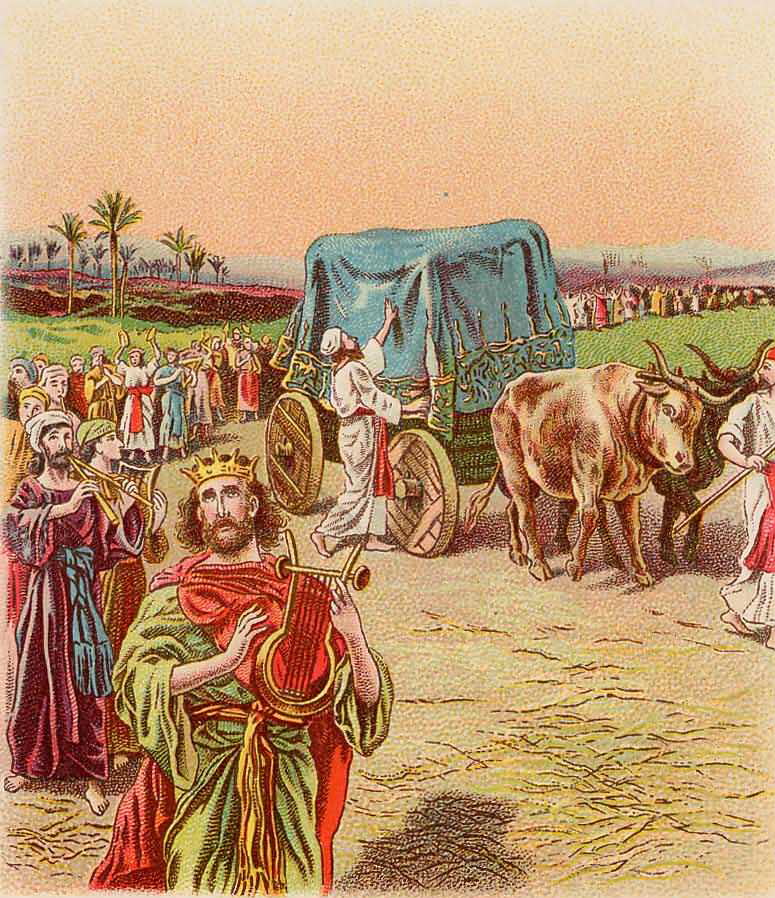
The first is the example of David, who danced when the Ark of the Covenant was brought to Jerusalem (II Samuel 6:14-16, I Chronicles 15:29). If seen through the lens of Jewish culture, this appears to be a celebratory folk dance like those following the Red Sea crossing in Exodus 15:20 or Goliath’s defeat in I Samuel 18:6. If it is an act of worship, it is the only record of such. Frankly, there is no indication this David’s dance is an example for us to follow.

The second is the final two Psalms. Those who defend the use of dancing say that these Psalms detail how we should worship and praise God because they begin with commands to “sing… his praise in the congregation of saints” (Psalm 149:1) and “praise God in his sanctuary” (Psalm 150:1). They will often claim this is descriptive of Temple worship.

However, Psalms 149 and 150 are not exclusively about Temple worship. They are the grand climax of the Psalms that extol all people at all times in all places to praise God. Psalm 149 is clear on this. Vs. 5 talks about praise in the nighttime – “let them sing aloud upon their beds.” Vs. 6 and following talks about praise in battle – “Let the high praises of God be in their mouth, and a twoedged word in their hand.” To be consistent, if you claim 149:3 commands or commends dance in worship then you should also see the same emphasis on using beds and swords.

Another issue with using Psalms 149 and 150 is the artistic language of the Hebrew poetry. Many well-meaning people misinterpret Hebrew poetry by taking it too literally or doing so inconsistently. Psalm 150 is a great example of this. It is not commanding us to praise God only with trumpets, psalteries, harps, timbrels, dances, stringed instruments, organs, and symbols. It is not even saying we must use those means. It is poetically imploring us to joyfully praise God with any proper means at our disposal. It is like the famous Winston Churchill quote about defending Britain from Nazi invasion: “We shall fight on the beaches, we shall fight on the landing grounds, we shall fight in the fields and in the streets, we shall fight in the hills; we shall never surrender.” Churchill is not saying that beaches, landing grounds, fields, streets, and hills are the only places they would fight. He is artistically stating that they will fight the foe on any ground.

Why?

I have attempted to be honest and open-minded in approaching the subject of physical expression in worship. I cannot find a good Scriptural basis for the promotion of it as we see so much of today. However, I cannot find clear prohibitions against it.

Like I said in the opening of this chapter, we are dealing with a subject that is largely governed by Christian liberty. To each his own, right? Sort of.

The biggest issue is why would we encourage physical expression in worship. This question is often overlooked in the discussion as we chase down verses and definitions and such. We must address why to clear up the entire debate.

Some will claim that the why is an attempt to be obedient to the clear teaching of Scripture. I think I have demonstrated in this chapter that this is not the case.

Some will claim the why is an attempt to restore a true means of worship that has been forgotten or lost. I highly doubt God would let His people forget how to properly worship Him for over two thousand years.
Some will claim the why is breaking down barriers in our hearts so that we can experience unbridled worship. This is New Age philosophy and not Bible doctrine. We are nowhere commanded to “follow our hearts” because our fallen and depraved nature is untrustworthy (Jeremiah 17:9).

Some will claim the why is to allow the Holy Spirit to move believers. This creates something like a self-fulfilling prophecy. If you are promoting actions that you think the Holy Spirit would do, then you are also promoting people perform those actions as proof of the Holy Spirit’s working. You are getting what you expect and denying what you do not.

I think the why is that people are not satisfied with what God has already given them as means to worship. They want to worship God on their own terms. It is the same motivation as Caan’s offering in Genesis 4. It is the same motivation that led to the creation of the golden calf in Exodus 32. It is the same motivation that led Peter to want to build three tabernacles in Luke 9:33. It is the same motivation that led many early believers to be burdened with the customs of the Mosaic Law. All these thought they too had found a better, newer, more effective way of worshipping God.

Christian Maturity

Careful study of the Scriptures will show that it is not unbridled passion or exuberant praise that marks a mature believer. It is the opposite: temperance, sobriety, and soundness of mind. Note the following verses and the underlined words and phrases:

“But the fruit of the Spirit is love, joy, peace, longsuffering, gentleness, goodness, faith, Meekness, temperance: against such there is no law.” – Galatians 5:22-23

“Likewise must the deacons be grave, not doubletongued, not given to much wine, not greedy of filthy lucre; Holding the mystery of the faith in a pure conscience.” – I Timothy 3:8-9

“For God hath not given us the spirit of fear; but of power, and of love, and of a sound mind.” – II Timothy 1:7

“For a bishop must be blameless, as the steward of God; not selfwilled, not soon angry, not given to wine, no striker, not given to filthy lucre; But a lover of hospitality, a lover of good men, sober, just, holy, temperate; Holding fast the faithful word as he hath been taught, that he may be able by sound doctrine both to exhort and to convince the gainsayers.” – Titus 1:7-9

“But speak thou the things which become sound doctrine: That the aged men be sober, grave, temperate, sound in faith, in charity, in patience.” – Titus 2:1-2

“For the grace of God that bringeth salvation hath appeared to all men, Teaching us that, denying ungodliness and worldly lusts, we should live soberly, righteously, and godly, in this present world; Looking for that blessed hope, and the glorious appearing of the great God and our Saviour Jesus Christ; Who gave himself for us, that he might redeem us from all iniquity, and purify unto himself a peculiar people, zealous of good works.” – Titus 2:11-14

“Be sober, be vigilant; because your adversary the devil, as a roaring lion, walketh about, seeking whom he may devour: Whom resist stedfast in the faith, knowing that the same afflictions are accomplished in your brethren that are in the world.” – I Peter 5:8-9

“And beside this, giving all diligence, add to your faith virtue; and to virtue knowledge; And to knowledge temperance; and to temperance patience; and to patience godliness; And to godliness brotherly kindness; and to brotherly kindness charity.” – II Peter 1:5-7

It is clear that a spiritually mature believer is not marked by reckless abandoning themselves in uninhibited worship. If anything, that description would apply to the weak or immature believer. These need to be encouraged “to put away childish things” and grow into richer and deeper understanding of worship.

Is “Tyrant” Missing From The KJV?

From time to time I hear a claim that King James I interfered with the translation of the Bible he sponsored by demanding words or phrases not be used. There is no evidence of this ever occurring. The only directions we are aware of are fifteen guidelines for the translation process.

Today, I came across a claim on Twitter (original video above) that James did not want the word tyrant used in his translation. That video claims, “But King James didn’t like this word, so he took it out and replaced it with something different.” James was an advocate of the divine right of monarchy to rule (and wrote about it), and so it is claimed that he would be sensitive to criticism of a such a monarchy as “tyranny”.

Translation Comparison

The primary comparison used is KJV with the Geneva Bible, with some attention paid to other earlier translations like the Bishop’s Bible or the Coverdale Bible. Using BibleHub and BibleGateway, here are the relevant verses compared:

  • Job 3:17
    • Hebrew – Strong’s H7267
    • Geneva Bible – “The wicked have there ceased from their tyranny, and there they that labored valiantly, are at rest.”
      • Also in Bishops and Coverdale.
    • KJV – “There the wicked cease from troubling; and there the weary be at rest.”
    • Other translations use words like “trouble” or “raging”
  • Job 6:23
    • Hebrew – Strong’s H6184
    • Geneva Bible – “And deliver me from the enemy’s hand, or ransom me out of the hand of tyrants?”
      • In Bishops but not Coverdale
    • KJV – “Or, Deliver me from the enemy’s hand? or, Redeem me from the hand of the mighty?”
    • Other translations use “ruthless, except the NASB which does use tyrant”.
  • Job 15:20
    • Hebrew – Strong’s H6184
    • Geneva Bible – “The wicked man is continually as one that travaileth of child, and the number of years is hid from the tyrant.”
      • Also in Bishops and Coverdale
    • KJV – “The wicked man travaileth with pain all his days, and the number of years is hidden to the oppressor.”
    • Other translations are mainly “ruthless”
  • Job 27:13
    • Hebrew – Strong’s H6184
    • Geneva Bible – “This is the portion of a wicked man with God, and the heritage of tyrants, which they shall receive of the Almighty.”
      • Also in Bishops and Coverdale
    • KJV – “This is the portion of a wicked man with God, and the heritage of oppressors, which they shall receive of the Almighty.”
    • Other translations: NASB has “tyrants” while others vary.
  • Psalm 54:3
    • Hebrew – Strong’s H6184
    • Geneva Bible – “For strangers are risen up against me, and tyrants seek my soul: they have not set God before them. Selah.”
      • In Bishops but not Coverdale.
    • KJV – “For strangers are risen up against me, and oppressors seek after my soul: they have not set God before them. Selah.”
    • Other translations mainly have “ruthless” or “violent men”
  • Isaiah 13:11
    • Hebrew – Strong’s H6184
    • Geneva Bible – “And I will visit the wickedness upon the world, and their iniquity upon the wicked, and I will cause the arrogancy of the proud to cease, and will cast down the pride of tyrants.”
      • Also in Bishops and Coverdale
    • KJV – “And I will punish the world for their evil, and the wicked for their iniquity; and I will cause the arrogancy of the proud to cease, and will lay low the haughtiness of the terrible.”
    • Other translations have a mix of words like “tyrant” or “ruthless”
  • Isaiah 49:25
    • Hebrew – Strong’s H6184
    • Geneva Bible – “But thus saith the Lord, Even the captivity of the mighty shall be taken away: and the prey of the tyrant shall be delivered: for I will contend with him that contendeth with thee, and I will save thy children,”
      • Not in Bishops or Coverdale
    • KJV – “But thus saith the LORD, Even the captives of the mighty shall be taken away, and the prey of the terrible shall be delivered: for I will contend with him that contendeth with thee, and I will save thy children.”
    • Most other translations have “tyrant”.
  • Jeremiah 15:21
    • Hebrew – Strong’s H6184
    • Geneva Bible – “And I will deliver thee out of the hand of the wicked, and I will redeem thee out of the hand of the tyrants.”
      • Also in Bishops and Coverdale
    • KJV – “And I will deliver thee out of the hand of the wicked, and I will redeem thee out of the hand of the terrible.”
    • Other translations mostly have “cruel”, “ruthless” or “violent”, but a few do have “tyrant”.
  • James 2:6
    • Not found in Greek.
    • Geneva Bible – “But ye have despised the poor. Do not the rich oppress you by tyranny, and do they not draw you before the judgment seats?”
      • Also in Bishops, but not Coverdale or Tyndale.
    • KJV – “But ye have despised the poor. Do not rich men oppress you, and draw you before the judgment seats?”
    • Most other translations do not have a parallel, a few have “exploit”

Regarding the Geneva Bible

The Geneva Bible was a tremendous achievement. It is essentially the world’s first “study Bible”, with notes, maps, and other features found in most Bible printed today. It did a great job of translation and was the primary Bible of English Protestantism for almost a century.

However, the downfall of the Geneva Bible is likely attributed to the added notes, in which are found many strong political statements. Remember that the Reformation was not just religious, it was political. For example of political commentary is found in a note in Daniel 11:36 states “So long the tyrants shall prevail as God hath appointed to punish his people: but he showeth that it is but for a time.” Simply put, the Geneva Bible was a politically disruptive force.

Historical Language Analysis

Today word tyrant might mean “an absolute ruler unrestrained by law or constitution” or “a ruler who exercises absolute power oppressively or brutally”.

In the ancient world it was a little different. The word tyrant comes from Greek, where it described opportunists that seized power with little or no right to do so. Originally it did have any connotation, good or bad, but developed a bad one over time.

As Western society progressed into the Enlightenment, tyranny became something to be despised. John Locke described it as “the exercise of power beyond right, which nobody can have a right to; and this is making use of the power any one has in his hands, not for the good of those who are under it, but for his own private, separate advantage.”

Old Testament Language Analysis

Because of the Greek heritage of the word and idea behind a tyrant, there really is not clear equivalent in ancient Hebrew.

Hebrew – Strong’s H7267

The Geneva Bible translated this word as “tyrant” only in Job 3:17.

Strong’s defines as “commotion, restlessness (of a horse), crash (of thunder), disquiet, anger — fear, noise, rage, trouble(-ing), wrath.”

Conclusion – Tyranny is probably not the best word here. It is describing the actions of the wicked as being turbulent, nothing inherently tyrannical here.

Hebrew – Strong’s H6184

This word is translated 7x in the Geneva Bible as “tyrant”. It occurs 20x overall

Strong’s defines as “fearful, i.e. Powerful or tyrannical — mighty, oppressor, in great power, strong, terrible, violent.”

Conclusion – Tyrant is not a bad translation of this word, but it is one application of a broader idea, which is “something to be feared that is mighty and oppressive”. Some appearances like Proverbs 11:16 or Jeremiah 20:11 do not contain the idea of being a tyrant. Again, “tyrant” is not an inaccurate translation in some cases but it is definitely not an equivalent for the Hebrew word.

New Testament Language Analysis

As we saw above, the only appearance of “tyrant” in the Geneva Bible’s New Testament in James 2:6 does not appear to have a textual basis. I’ll leave figuring that out to someone else, but I will show you the one time “tyrant” appears in the Greek New Testament: Acts 19:9. Yes, the name Tyrannus (Strong’s G5181) literally means “tyrant”.

Conclusion

So, according to the argument presented in the beginning, King James I did not like the word tyrant because it could be thought of as critical of his monarchy. He then supposedly directed the translators of the KJV to not use the word “tyrant”. We cited the references in the Geneva Bible (and others) that use the word tyrant where the KJV does not.

Case closed, right?

No, because the presented argument is critically flawed.

All we must do to utterly destroy the argument is show that the KJV does include the word tyrant. This completely undermines the foundation for the argument.

But didn’t we admit that the KJV does not contain the word tyrant? Yes and no.

What we proved above is that tyrant is not found in the Old or New Testaments of the KJV.

Here is the fatal flaw: no one that presents this argument bothered to look in the Apocrypha of the original KJV. If anyone had bothered to do so, you will quickly find that the word tyrant appears 3x in the KJV Apocrypha:

  • Wisdom of Solomon 12:14 – “Neither shall king or tyrant be able to set his face against thee for any whom thou hast punished.”
  • II Maccabees 4:25 – “So he came with the king’s mandate, bringing nothing worthy the high priesthood, but having the fury of a cruel tyrant, and the rage of a savage beast.”
  • II Maccabees 7:27 – “But she bowing herself toward him, laughing the cruel tyrant to scorn, spake in her country language on this manner; O my son, have pity upon me that bare thee nine months in my womb, and gave thee such three years, and nourished thee, and brought thee up unto this age, and endured the troubles of education.”

It should not be a surprise that Wisdom of Solomon and II Maccabees were originally written in Greek. The original writes used the Greek term for tyrant and the English translators used the English equivalent.

So, to counter the original argument:

  • King James could not have forbidden the use of the word tyrant because it does appear in the work of the translators within the Apocrypha.
  • The Greek etymology and heritage of tyrant makes it anachronistic to use in ancient Hebrew, meaning there is not equivalent that must be translated as such.

Oh, and I guess since the word “pudding” isn’t used in the KJV that James must have directed the translators to not talk about British desserts.

Acts 9:31 – “Church” or “Churches”?

Why do some Bible translations use “church” and others “churches in Acts 9:31? Which is the correct reading?

Photo by Dan Mall on Unsplash

I recently came across a difference between Bible translations that I feel greatly affects what the Bible teaches about the nature of the church. I found very little information regarding this, so I thought I would share what I have found so far in studying it.

Background Context

The first 3/4s of Acts chapter 9 is the record of Saul’s conversion. Saul of Tarsus had menaced the church at Jerusalem after Stephen’s death, causing many believers to flee from Jerusalem to surrounding areas. But God had greater plans for Saul, and through a divine encounter on the road to Damascus Saul was wondrously converted.

Saul proved to be a controversial convert. Many Christians feared him because he had so recently persecuted them. He also proved zealous to the extreme, preaching so boldly that twice his enemies sought to kill him. He is sent back to his home in Tarsus to escape these threats.

This brings us to verse 31, which tells that state of the believers. The believers that had been centered in Jerusalem are now found throughout the regions of Judea, Samaria, and Galilee. Their faith and numbers continued to grow through the blessings of the Lord.

Singular or Plural?

When comparing different English translations of the New Testament, there is a marked difference in the opening words of Acts 9:31.

VersionText
King James VersionThen had the churches rest throughout all Judaea and Galilee and Samaria…
New International VersionThen the church throughout Judea, Galilee and Samaria…
New Living TranslationThe church then had peace throughout Judea, Galilee, and Samaria…
English Standard VersionSo the church throughout all Judea and Galilee and Samaria…
New American Standard BibleSo the church throughout Judea, Galilee, and Samaria…
Legacy Standard BibleSo the church throughout all Judea and Galilee and Samaria…
Christian Standard BibleSo the church throughout all Judea, Galilee, and Samaria…
American Standard VersionSo the church throughout all Judea and Galilee and Samaria…
New Revised Standard VersionMeanwhile the church throughout Judea, Galilee, and Samaria…
Geneva Bible (1587)Then had the Churches rest through all Iudea, and Galile, and Samaria…
Coverdale Bible (1535)So the congregacions had rest thorow out all Iewry, and Galile, and Samaria…
Tyndale Bible (1526)Then had ye congregacios rest thorowoute all Iewry and galile and Samary…
Douay-Rheims BibleNow the church had peace throughout all Judea, and Galilee, and Samaria…
Source – BibleHub

While the King James Version and other older translations have a plurality of churches/congregations, almost all recent translations have a singular church.

The issue also appears when comparing the various Greek texts.

Greek TextGreek WordSingular/Plural
Beza (1598)ἐκκλησίαSingular
Stephanus Textus Receptus (1550)ἐκκλησίαιPlural
Scrivener’s Textus Receptus (1894)ἐκκλησίαιPlural
Tischendorf (1872)ἐκκλησίαSingular
Greek Orthodox (1904)ἐκκλησίαιPlural
Westcott and Hort (1881)ἐκκλησίαSingular
Nestle (1904)ἐκκλησίαSingular
Source – BibleHub

Commentaries

In my opinion, most commentaries that touch the subject do very poorly, as seen in this roundup of those found on BibleHub:

  • Ellicott’s Commentary – “The better MSS. have ‘the Church’ in the singular.”
  • Meyer’s NT Commentary – “Observe, moreover, with the correct reading ἡ μὲν οὖν ἐκκλησία κ.τ.λ. the aspect of unity, under which Luke, surveying the whole domain of Christendom, comprehends the churches which had been already formed (Galatians 1:22), and were in course of formation (comp. Acts 16:5).”
  • Expositor’s Greek Testament – “αἱ ἐκκλησίαι—if we read the singular ἡ ἐκκλ. with the great MS. the word shows us that the Church, though manifestly assuming a wider range, is still one: Hort, Ecclesia, p. 55, thinks that here the term in the singular corresponds by the three modern representative districts named, viz., Judæa, Galilee, Samaria, to the ancient Ecclesia, which had its home in the whole land of Israel; but however this may be, the term is used here markedly of the unified Church, and in accordance with St. Paul’s own later usage of the word; see especially Ramsay, St. Paul, pp. 126, 127, and also p. 124.”
  • Cambridge Bible for Schools and Colleges – “In the best texts the noun and all the verbs agreeing with it are in the singular number, and what is meant is the whole Christian body, not the various congregations.”
  • Vincent’s Word Studies – “The best texts read the church; embracing all the different churches throughout the three provinces of Palestine.”
  • Jamieson-Fausset-Brown – “Then had all the churches rest—rather, ‘the Church,’ according to the best manuscripts and versions.”
  • Gill’s Exposition – “The Alexandrian copy, and some others, the Vulgate Latin, Syriac, and Ethiopic versions, read in the singular number, ‘the church’: but the several countries hereafter mentioned shows that more are designed…”

Lange’s Commentary has this footnote (note – the bracketed sections are in the original, not added by me):

  • “Acts 9:31. H—ἐκκλησία—ἐπληθύνετο; this is the reading of A. B. C., and. as it has recently appeared, also of Cod. Sin. as well as of many manuscripts of the second rank, of the majority of the Oriental versions, and also of the Vulgate, and of Dionysius of Alex. On the other hand, the plural [text. rec.], (αἱ—ἐκκλησίαι (πᾶσαι E.) ει̇͂χον .. ἐπληθύνοντο) is found in E. G. H. and some other manuscripts. As the latter generally belong to a later period, and as most of the ancient versions exhibit the singular, this is far better attested than the plural, and has been preferred by Griesbach, Lachmann, Tischendorf and Bornemann [Stier and Theile, and Alford, with whom de Wette concurs. Meyer had, in earlier editions, espoused the opposite view, but in the last edition of his Commentary (3d, 1861) unhesitatingly adopts the singular as the original reading, and as ‘expressive of the apostolical conception of the unity of the Church.’—TR.]. The plural is to be regarded as an explanation. [The word ἐκκλῃσία, in the singular, used for the whole body of Christians, or the Church universal, occurs, e. g., in Matth. 16:18; Acts 20:28; 1 Cor. 10:32; 12:28; Eph. 1:22.—TR.]”

William Kelly has this footnote:

  • “The singular is read by ABC Vulg. Syr. Pst., Sah. Cop. Arm. Æthiop, Erp Arab., et al., as against the plural of the Text. Rec. HLP Syr. Hcl (and E, ἐκκλησίαι πᾶσαι).”

Better/Best Manuscripts?

As you can see, many of the commentaries above support the singular church in Acts 9:31 on the basis of it being in the “better” or “best” manuscripts. This level of hubris is common after the rise of Higher Criticism in the 18th and 19th centuries. It assumes that the Bible texts used by Protestant and other non-Catholic groups (basically the Majority Text) since the earliest days of Christendom was seriously flawed with various corruptions and errors. It assumes that variant readings are superior to the historically accepted ones if their source document is (a) older or (b) deemed more trustworthy through various factors. Thus new Critical/Eclectic Greek texts are produced incorporating the textual changes.

Certain problems arise. First: there is a general assumption of doubt as to the reliability of the word of the traditional textual readings. Second: much of the criteria for determining alternative readings has openings for error. For example, the rule of “older is better” assumes the older document is less corrupt based on age, with little regard to any possibility that it could be more corrupt and less trustworthy. Three: the final authority shifted from the text itself to the opinions of scholars. Four: the temptation to achieve notoriety and prestige pushes scholars to seek corrections even when not warranted instead of supporting an established text.

The support for a singular church in Acts 9:31 comes primarily from accepting the “older is better” argument. It is argued that older manuscripts like the Vaticanus (4th century) or older translations like the Vulgate (4th century) contain the singular church. It further ignores other “old” manuscripts that support a plural churches, as in the Laudianus (6th century):

Source (see fol. 78)

Since there are both “old” manuscripts that attest to a plural churches and a centuries-long tradition of interpreting the verse as such, it is disingenuous to ignore that there is a case to be made for its acceptability.

If the textual evidence is inconclusive, then let us look at the theology.

Usage of Ecclesia in Acts

Luke is an astute and careful chronicler of history. Time after time the language he uses has been tested and proven correct. I would contend that the same goes for his uses of the church or churches.

The chart below shows every use of ecclesia in the Book of Acts according the the Textus Receptus. I am including notes to show that each singular use of ecclesia refers to singular church, while each plural use of ecclesia refers to a plurality of churches. I also am including the references for ecclesia that do nor refer to the Christian church.

ReferencesGreekSingular/PluralNote
Acts 2:47εκκλησιαSingularThe singular church at Jerusalem.
Acts 5:11εκκλησιανSingularThe singular church at Jerusalem.
Acts 7:38εκκλησιαSingularThe singular nation of Israel.
Acts 8:1εκκλησιανSingularThe singular church at Jerusalem.
Acts 8:3εκκλησιανSingularThe singular church at Jerusalem.
Acts 9:31εκκλησιαιPluralThe plural churches of Judea, Galilee, and Samaria
Acts 11:22εκκλησιαςSingularThe singular church at Jerusalem.
Acts 11:26εκκλησιαSingularThe singular church at Antioch.
Acts 12:1εκκλησιαςSingularThe singular church at Jerusalem.
Acts 12:5εκκλησιαςSingularThe singular church at Jerusalem.
Acts 13:1εκκλησιανSingularThe singular church at Antioch.
Acts 14:23εκκλησιανSingular“each church” – churches of Lystra, Iconium, and Derbe
Acts 14:27εκκλησιανSingularThe singular church at Antioch.
Acts 15:3εκκλησιαςSingularThe singular church at Antioch.
Acts 15:4εκκλησιαςSingularThe singular church at Jerusalem.
Acts 15:22εκκλησιαSingularThe singular church at Jerusalem.
Acts 15:41εκκλησιαςPluralThe plural churches of Syria and Cilicia
Acts 16:5εκκλησιαιPluralThe plural churches of Lystra, Iconium, and Asia Minor
Acts 18:22εκκλησιανSingularThe singular church at Caesarea.
Acts 19:32εκκλησιαSingularThe singular political assembly at Ephesus.
Acts 19:39εκκλησιαSingularThe singular political assembly at Ephesus.
Acts 19:41εκκλησιανSingularThe singular political assembly at Ephesus.
Acts 20:17εκκλησιαςSingularThe singular church at Ephesus.
Acts 20:28εκκλησιανSingularThe singular church at Ephesus.

I contend that Luke’s use of the singular or plural ecclesia is instructive. When he refers to a singular church there is a singular local church to be the object. When he refers to plural churches there is a region or multiple cities containing many churches.

Excluding Acts 9:31, there is not a single other reference where a singular church refers to a anything but a singular local church. Acts 15:41 and 16:5 prove that a plural usage is acceptable and appropriate, and there appears to be no debate as to whether or no those be plural.

Acts 15 clearly shows that the singular ecclesia should refer to a local church and not a universal church. The church at Antioch is upset by the teaching of some visitors from the church at Jerusalem. In vs. 3, Paul and Barnabas are sent by the church at Antioch to the church at Jerusalem and stop and visit with other believers along the way. This shows at least two distinct churches, with other churches or gatherings along the way. In vs. 4, the church at Jerusalem welcomes Paul and Barnabas. In vs. 22, the church at Jerusalem decides to send men back to the church at Antioch with Paul and Barnabas. In vs. 41, Paul and Silas visit multiple churches in the regions of Syria and Cilicia.

So then, when the Book of Acts is examined as a whole it is clear that Luke purposefully and appropriately uses the singular and plural forms of ecclesia. When referring to a singular church in a singular city, he uses the singular. When referring to a plurality of churches in a region or groups of cities, he uses the plural.

Why then would he break from this consistency to use a singular church in Acts 9:31 to refer to many assemblies of believers in a region? Because he does not. Our survey shows that the plural churches must be the correct word based on how Luke uses it.

Theological Implications

The traditional Baptist interpretation of the Scriptures holds that there a many local assemblies of believers that a called churches. It holds that each is autonomous in government. It rejects the ideas of a “universal” or “invisible” church as being incompatible with how the Bible describes the local assemblies.

If Acts 9:31 does indeed have a singular church, then it would stand against the idea of local congregations being individual churches. It would go against how Paul writes about to and about churches. It would go against how Christ deals with the Seven Churches in Revelation. It would open the door to ecclesiastical hierarchy. It would stand against autonomous governance of local assemblies.

If you are unfamiliar with the idea of ecclesia and church referring to local congregations and not a larger conglomeration of congregations, then I would challenge you to study how the Bible describes churches. If there are plural churches, there cannot be one universal church.

Final Thoughts

We are left to assume that an error has crept into Biblical texts. Where it came from we do not know but surely it came very early.

The question is whether church or churches is the mistake in Acts 9:31. The two are incompatible so one must be correct and the other false.

Yes, a case can be made from extent Biblical manuscripts that church is correct. Yet, that case is not as sure as it is presented. If there is logically an error that has been introduced, why not conclude that these manuscripts contain error? Can you conclusively prove otherwise?

I realize much will come down to opinion. Someone will read this and mock me as being foolish and ignorant regarding textual criticism and its intricacies. Yet, the nature of that field of study at its highest levels assumes that everything must be continually questioned. Why not question which word is appropriate in Acts 9:31?

My basis for accepting the plural churches in Acts 9:31 are as follows:

  • There is a reasonable case to be made that it is the correct word based on textual history.
  • It has been the standard interpretation for much of Christianity for much of the time.
  • It is the correct word based on Luke’s consistent usage of it.
  • It is consistent with the usage in the rest of the New Testament.
  • There is more to gain by purposefully altering the word from plural to singular than vice versa.

Brass or Bronze?

Compare Bible translations or references and you may notice a difference in how the Hebrew word nechosheth (Strong’s H5178) is treated. There are three possible translations that are asserted: copper, brass, or bronze. Which is accurate?

The KJV translates nechosheth as “brass” or “brazen” 131x. It can also be translated as other things, such as “fetters” or “chains” based on context. It has a very broad application. Strong’s defines it as “copper; hence, something made of that metal, that is, coin, a fetter; figuratively base (as compared with gold or silver): – brasen, brass, chain, copper, fetter (of brass), filthiness, steel”.

Is brass a proper and acceptable translation of nechosheth? Some claim it cannot be, by asserting:

  • “In ancient Israel there was no such metal known as brass.” [source]
  • “The word translated ‘brass’ in the King James Version would be more correctly translated bronze, since the alloy used was copper and tin (Ex 27:4).” [source]
  • “[Brass,] which is an alloy of copper and zinc, was not known till the thirteenth century. What is designated by this word in Scripture is properly copper (Deuteronomy 8:9).” [source]
  • “The word nechosheth is improperly translated by ‘brass.’ In most places of the Old Testament the correct translation would be copper, although it may sometimes possibly mean bronze a compound of copper and tin.” [source]

We may simplify these claims into two arguments: (1) the term brass is anachronistic and inaccurate, and (2) brass did not exist in the ancient world.

Is brass an inaccurate term?

In modern English, the word brass refers to a specific alloy of copper, but until the 1700’s is would be a more general term for any copper alloy.

The Online Etymological Dictionary states that brass was “originally any alloy of copper, in England usually with tin (this is now called bronze), later and in modern use an alloy of roughly two parts copper to one part zinc.” The same source also states: “In Middle English, the distinction between bronze (copper-tin alloy) and brass (copper-zinc alloy) was not clear, and both were called bras”.

So, etymologically and historically speaking, brass has been a much broader term to refer to any copper alloy. This changed in the 1700’s when advances in science made it easier to discern different elements and alloys, which also brought a need for more technical terminology. Wikipedia states of brass: “…its true nature as a copper-zinc alloy was not understood until the post-medieval period because the zinc vapor which reacted with copper to make brass was not recognised as a metal.” As part of this new knowledge of metals, the term bronze was first used around 1721 (see Online Etymological Dictionary and Merriam-Webster).

Therefore, we see that brass is historically as broad of a term as nechosheth. In the English of the KJV, it is the best and most accurate term.

But, with what we know today about the differences between brass and bronze, is brass still an accurate translation for today’s world? This can only be answered if we are absolutely sure that nechosheth refers exclusively to bronze and that brass is an impossibility.

Did brass exist in the ancient world?

It is clear that the alloy we today call brass was present in the ancient world. Conclusive evidence and scholarly opinion establish this fact. A few examples:

  • The Roman dupondius coin used in the early Roman Empire was often struck in a type of brass called orichalcum [source]
  • “Calamine brass” was being made in Asia Minor as far back as the 1st millennium B.C. [source]
  • “…numerous copper-zinc alloys (e.g. brass, gunmetal) that have been found in prehistoric contexts from the Aegean to India in the 3rd to the 1st millennium BC.” [source]
  • Brass artifacts have been discovered from 5th millennium B.C. in China [source]

Since (1) brass existed in the ancient world, (2) since nechosheth is vague at best about the precise alloy of the metal, we can therefore safely say it is plausible that the metals described could be actual brass.

Do we know what the metals were?

Since the term nechosheth, and even the Greek word chalkos (Strong’s G5475), are vague terms for copper or its alloys, we simply cannot say for certain the precise metal they are speaking of. The terminology is too vague and the ancient metallurgists themselves almost certainly did not have the sophisticated understanding of metal composition we have today.

It must be state that according to history and archeology that bronze was in far greater use than brass. It was far cheaper and easier to produce, and it would appear that ancient brass was considered to be more valuable. We might assume that because bronze was more common that it is more likely that bronze and not brass is being referred to. But this is purely supposition and we cannot rule out that at least some appearances of nechosheth could be referring to brass. We simply do not know since we cannot examine every object made of nechosheth.

Conclusion

The truest definition of nechosheth would need to be vague and inclusive, so “a copper alloy” is probably the best definition. In modern English, there just is not a simple, concise word to use that has that same meaning and “copper alloy” fails to be an workable translation. To try to force nechosheth to be simply bronze is inaccurate: an interpretation rather than a translation. We cannot honestly say what the metals used were by modern classification. It is like trying to take the English word snow and determine which of the dozens of terms of snow used by Eskimos it should be.

The word brass in its classic, KJV English definition is the best equivalent term to be found. It is the same broad term for any copper alloy that we see in nechosheth.

The Mysterious Tabernacle of David

Recently, I have made a few posts concerning elements of Charismatic/Pentecostal theology. This has been brought on by my recent studies of the theology behind Praise & Worship music. In this post, I have another element that I feel needs to be addressed: the so-called Tabernacle of David.

Historical Account

When reading the Scriptures and arriving at II Samuel chapter 6, you will find King David’s desire to bring the Ark of the Covenant to his new capital at Jerusalem. To understand how this came to be, we need to examine the history of the Ark and the Tabernacle of Moses leading up to this point:

  • c. 1150 B.C. – The Tabernacle of Moses and Ark are together at Shiloh, where they had been for over three centuries. – Joshua 18:1, Judges 18:31, I Samuel 1:3, 2:3
  • 1122 B.C. – The Ark is removed from the Tabernacle of Moses and brought to the war camp of the Israelites at Ebenezer, maybe 18-20 miles west of Shiloh. This First Battle at Ebenezer was a terrible defeat of the Jews by the Philistines. The Ark was captured in the battle and in the rout that followed it is believed by some that Shiloh was sacked or destroyed. – I Samuel 4:1-11, Jeremiah 7:12
  • 1121 B.C – The Ark spends seven months in the hands of the Philistines. It is was moved among their capitals of Ashdod, Gath, and Ekron. In each of these locations God cursed the inhabitants while they possessed the Ark. – I Samuel 5:1-6:1
  • 1121 B.C. – The Philistines send the Ark back to Israel by placing it on a cart pulled by two untamed milk cows. It arrives in Bethshemesh, where the Israelites there do not respect the Ark by opening it and God punishes their lack of reverence. – I Samuel 6:2-20
  • 1121 B.C. – The Ark is taken to Kirjathhearim, where it stays in the house of Abinidab. – I Samuel 6:21-7:2
  • 1065 B.C. – David flees from Saul’s court and arrives at Nob. He is given shewbread by Ahimelech, implying that at least some of the Tabernacle furniture and setup is present there. The large number of priests and the high priest himself also suggest something special about this site. Based on the evidence, we assume that some form of the Tabernacle of Moses (minus the Ark) existed at Nob when David visited there. When and how it came to be here from its last appearance at Shiloh is unknown. – I Samuel 21:1-9
  • 1046 B.C. – David attempts to bring the Ark to Jerusalem by placing it on a cart. Uzzah is killed when he attempts to steady the Ark on the cart. The Ark is placed in the house of Obededom, where it stays for the next three months. – II Samuel 6:1-11, I Chronicles 13:1-14
  • 1046 B.C. – David brings the Ark to Jerusalem, amid sacrifices and singing. It is placed in a specially constructed tent/tabernacle, the Tabernacle of David. – II Samuel 6:12-19, I Chronicles 15:1-16:37
  • 1046 B.C. – David organizes the service of the Levites to serve in two locations: before the Ark in Jerusalem and at the Tabernacle of Moses which was now in Gibeon. It is assumed that the Tabernacle of Moses moved to Gibeon after the slaughter of the priests at Nob by Doeg in I Samuel 22:6-23 This separation remained until the completion of the Temple by Solomon in 1004 B.C. – I Chronicles 16:37-43, 21:29; II Chronicles 1:3

There are a few great questions that come to mind:

First, why were the Ark and Tabernacle of Moses not reunited? Some speculate that the Tabernacle of Moses was worn out, damaged, or incomplete and thus unable to be moved or possibly even to properly function. It has even been suggested that this was a move by David to force the other tribes to submit to his rule. Some even think that this was David’s self-will not part of God’s design. One person suggests that David kept the Ark like a petulant toddler because he was unable to go in the Tabernacle of Moses himself.

Sometimes, God chooses not to reveal His plans to us and we simply must trust in Him (Deuteronomy 29:29). That could very well be the case here, if it were not for a passage in Psalms that appears to explain God’s purpose.

In Psalm 78 is a rehearsal of God’s dealings with Israel as means of instruction of spiritual truths. I think A.C. Gaebelein summarizes it well:

“This historical retrospect needs no further comment. It is God speaking to the hearts of His people through their own history from Egypt to David. How graciously He dealt with them all the way! The crowning fact is His sovereign grace in choosing Judah, Mount Zion which he loved, building there His sanctuary, and choosing David His servant to feed Jacob His people and Israel His inheritance. Here we may well think of the Son of David, God’s Anointed in whom God’s sovereign grace is made known and who will yet feed Jacob and Israel His inheritance.”

Let’s examine Psalm 78:56-72:

  • 78:56-58 – The Israelites had turned their back on God. Even a casual Bible study of the events of Judges into I Samuel will show how the Jews continually turned away from God.
  • 78:59-61 – God turned away from His rebellious people and sent judgment in the capture of the Ark by the Philistines and the fall of Shiloh.
  • 78:62-64 – The judgment that fell on Israel is described.
  • 78:65-66 – The judgment that fell on the Philistines is described.
  • 78:67-68 – God rejected the Tabernacle and the powerful tribe of Ephraim that held it, instead choosing to lead through the tribe of Judah from mount Zion in Jerusalem.
  • 78:69 – The temple at Jerusalem is described.
  • 78:70-72 – The reign of David is described.

What does Psalm 78 teach us about the separation of the Ark and the Tabernacle of Moses? That it was a result of God’s judgment on Israel’s sin and that God was reforming their worship by establishing its new center in Jerusalem and the Temple.

Second, why did David place the Ark in its own new tent/tabernacle? Why not build something grander for it?

It appears that David saw this new tabernacle for the Ark (I am calling it the “Tabernacle of David” to differentiate it from the “Tabernacle of Moses”) as only a temporary dwelling. We see in II Samuel 7 that David had every intention of building a grand Temple. Even though God did not allow him to build it, we see his concern and preparation for its construction (I Chronicles 22). David was anxious for the day when God’s presence returned to Israel in a complete Tabernacle/Temple.

But David also realized that day had not arrived yet. The Tabernacle of David was a temporary structure that awaited something grander to replace it. Though they possessed the Ark and some blessing from their respectful keeping of it, God’s presence was not upon it like the days in the wilderness. This is emphasized in the fact that God’s presence fell in such a mighty way at the dedication of the Temple (II Chronicles 5:13-14) but no mention is made of any similar event for the Tabernacle of David.

Third, what actually happened at the Tabernacle of David?

Let’s do a rundown of actions we see there:

  • Sacrifices – II Samuel 6:17-18, I Kings 3:15
  • Gathering of the people – II Samuel 6:19
  • Corporate praise – I Chronicles 16:36
  • Personal Worship – II Samuel 12:20
    • NOTE – I’m honestly not 100% sure “house of the LORD” refers to the Tabernacle of David instead of the Tabernacle of Moses. It makes sense that he would go to the former rather than the latter since it was closer, but the use of the phrase “house of the LORD” generally refers to the Tabernacle of Moses or the Temple.
  • Music – I Chronicles 15:16-22, 16:42

Now, let’s look at the roles of the priests that served there:

  • Asaph and his family took care of day-to-day affairs – I Chronicles 16:37
  • Obededom and family were porters/doorkeepers – I Chronicles 16:38

Note that the names and positions that follow in I Chronicles 16:39-42 appear to be associated with the Tabernacle of Moses at Gibeon and not the Tabernacle of David at Jerusalem. It is interesting to find that this is the first reference to incorporating music in to the services at the Tabernacle of Moses.

The position of Asaph is interesting. If this is the same Asaph as in I Chronicles 6:39, 15:17, etc. (and there is little doubt that is the same person) then it is assumed that he must be exercising his musical abilities in this service. But Asaph could be acting in his position as a Gershonite. The Gershonites were the division of Levites charged mainly with carrying and caring for the decorative materials of the Tabernacle of Moses (Numbers 4:24-28). It is also interesting to note that Obededom was a Kohathite (I Chronicles 26:1-5), the division charged with carrying the “most holy things” of the Tabernacle of Moses (Numbers 4:4-14). Regardless, the presence of Asaph suggests but does not prove a musical program.

Historical Inaccuracies

The information above is the most concrete information we have on the Tabernacle of David. I have been quite surprised to see other claims with no basis in Scripture or history. Let’s examine a few:

1. The Tabernacle of David had only one compartment that corresponded with the Most Holy Place [source]

There is nothing mentioned in Scripture of the design or layout. This is pure conjecture.

2. There was unrestricted access for many/all into the presence of the Ark. [source]

Again, no basis for this claim. It actually goes against the way the Jews revered the Ark, even covering it when it was moved (Numbers 4:5-6).

3. There was constant, 24/7 praise, worship, and music before the Ark. [source]

The only basis for this claim is two assumptions. First, that Asaph and those under him were operating in a musical role. We simply have no concrete evidence of if or how music played a part in what they were doing. Second, that their ministry “continually, as every day’s work required” was 24/7/365. This can also be understood that they regularly did the requirements of each day. The similar language found in passages such as II Chronicles 8:14 and Ezra 3:4 supports this as a better interpretation.

4. David dwelt in his Tabernacle. [source]

The references cited for this claim are Psalms 23:6 and 27:4. However, in both of these David is speaking longingly of something he desired but did not possess.

5. God’s presence was in the Tabernacle of David. [source]

As we looked at before, there is no evidence for this claim. It is an assumption that God was present because the Ark was there. But God is not bound to one place or one piece of furniture. The strictest interpretation of Scripture would support the presence of God departing when the Philistines took the Ark (see I Samuel 4:21) and its return when Solomon dedicated the Temple.

6. The worship was marked by spontaneity. [source]

No evidence for this whatsoever.

7. The worship was marked by dancing. [source]

The only dancing that could be referred to was David’s dancing for joy before the Ark as it was carried to Jerusalem (2 Samuel 6:16). First, this is in connection with bringing the Ark and not with it resting in its new home. Second, David’s joyful expressions are wonderful in themselves but not a prescriptive command for others. Third, there is no reference to others emulating David’s action in that day.

8. The Tabernacle of David was open so all could see the Ark. [source]

No evidence for this. The sacred nature of the Ark would have most likely inspired them to keep it covered.

9. David initiated a new form of worship marked by singing, physical expression, etc. [source]

This assumption is based on many other assumptions about the sort of worship that went on in the Tabernacle of David. David did in fact do much to reorganize the priesthood and prepare for an expansion of the services of the Temple. Part of this does appear to be the introduction of music in to the Tabernacle/Temple services. But to insinuate that dancing, spontaneous singing, etc. were integrated into worship at this time and place is without sound Biblical basis.

The Prophetic Element

Having examined the historical background of the Tabernacle of David, let us move on the prophecy that some claim is related to it.

The first reference we will look at is in Isaiah chapter 16. This chapter and the previous one are together one prophecy against the nation of Moab. In the midst of this message to Moab, we find a striking prophecy in 16:5: “And in mercy shall the throne be established: and he shall sit upon it in truth in the tabernacle of David, judging, and seeking judgment, and hasting righteousness.”

The second reference is in Amos 9. This chapter deals with the fall of the kingdom of Israel into captivity with a promise that they will later be restored. We see in 9:11-12: “In that day will I raise up the tabernacle of David that is fallen, and close up the breaches thereof; and I will raise up his ruins, and I will build it as in the days of old: That they may possess the remnant of Edom, and of all the heathen, which are called by my name, saith the LORD that doeth this.”

The third reference is in Acts 15. The Apostles and the church at Jerusalem debated whether or not Gentile Christians were subject to the ordinances of the Law of Moses. There is much debate with testimonies from Peter, Paul, and Barnabas with no resolution. James the delivers a speech, declaring that the God had declared that He would save the Gentiles and not just the Jews. James quotes the prophecy from Amos 9 as proof of God’s plan of bringing salvation to the Gentiles. Let’s read his speech in full from Acts 15:13-21:

“And after they had held their peace, James answered, saying, Men and brethren, hearken unto me: (14) Simeon hath declared how God at the first did visit the Gentiles, to take out of them a people for his name. (15)  And to this agree the words of the prophets; as it is written, (16)  After this I will return, and will build again the tabernacle of David, which is fallen down; and I will build again the ruins thereof, and I will set it up: (17) That the residue of men might seek after the Lord, and all the Gentiles, upon whom my name is called, saith the Lord, who doeth all these things. (18) Known unto God are all his works from the beginning of the world. (19) Wherefore my sentence is, that we trouble not them, which from among the Gentiles are turned to God: (20) But that we write unto them, that they abstain from pollutions of idols, and from fornication, and from things strangled, and from blood. (21) For Moses of old time hath in every city them that preach him, being read in the synagogues every sabbath day.”

A few observations:

First, it was assumed by some interpreters that this prophetic tabernacle must be the physical Tabernacle of David that held the Ark. However, on closer examination there is no relation between these prophesies and Tabernacle of David.

Someone will surely object at this: “But it says the ‘tabernacle of David’! What other tabernacle did David have?” I’ll answer that in the next point.

Second, the use of the ‘tabernacle’ here is figurative for the kingdom and household of the royal line of David. That’s why Isaiah said it had a throne, which the physical Tabernacle of David did not have. That’s why Amos speaks of it possessing or ruling over foreign people and lands. It is speaking of a kingdom and its authority.

Third, note that the three prophetic verses (Isaiah 16:5, Amos 9:11, Acts 15:16) that speak of the “tabernacle of David” are the only verses in the Bible that use that exact phrase. That term is never actually applied to the tent that house the Ark. To be honest, it is somewhat anachronistic and indeed inappropriate to apply the term to the tent David used since this name appears here in a very different context. [Please recall that I have only used term “Tabernacle of David” to describe David’s tent for the Ark in order to differentiate it from the Tabernacle of Moses and because that is what others have called it.]

Fourth, someone, I believe in the past century or so, conflated the prophetic “tabernacle of David” with the physical “tabernacle that David had pitched for [the Ark]” (II Samuel 6:17). I can understand how it could be easily done, but any contextual analysis should show that two very different meanings are found between the physical and the prophetic. This is essentially the same as confusing Noah’s Ark and the Ark of the Covenant. Two very different things that are called the same name (in English, at least).

Fifth, these prophesies do not apply directly to the church at all. When James references Amos he is not saying, “The prophecy of Amos is fulfilled!” Instead, he is saying, “This is like a greater truth I see in the prophecy of Amos.” He is saying that Christ intends to bring the Gentiles into His Kingdom, so who were they to deny their entrance?

Sixth, the prophecies are clearly pointing to Christ’s future kingdom. He will reign upon the restored house/throne/kingdom/tabernacle of David. See Psalm 132:11-12, Isaiah 9:7, Jeremiah 17:25, etc.

The Source of the Confusion

The fountainhead for the confusion about the Tabernacle of David is most certainly in Pentecostal/Charismatic theology from the mid-20th century. Yes, there are those that did relate the prophetic and physical Tabernacles of David previous to them, as seen in the Jamieson-Fausset-Brown commentary on Amos 9:11. But the propagation and proliferation of studies on the Tabernacle of David we see today come directly from Pentecostal/Charismatic sources and influences.

The claim that is made is that the Tabernacle of David is a true model for worship that was lost/forgotten/neglected for centuries upon centuries. That model of worship is said to have been loud, animated, spontaneous, and musical. This model is further proposed as the only true way of worshipping God.

The next claim is that the prophecies, seen especially in Amos and Acts, are of a restoration of this lost form of worship that will appear in the “latter days”. It is proclaimed that through this restoration of true worship and royal authority that will reach the nations and ready the Bride of Christ.

Yes, if you have never been exposed to these teachings (and there are many variations) some people out here are literally teaching that God withheld the method for true and powerful worship for over 3,000 years and just recently decided to give it back to His people. The first group to start making these connections was likely the Latter Rain movement (See p. 46-47 of A History of Contemporary Praise and Worship). Now these teachings are infiltrating mainline denominations.

How did this happen? I think largely because it began with such an obscure reference in Biblical history that there was not a good counter to their claims. There was not (and is still not as far as I can tell) a well developed understanding of what exactly happened at that tent that David that can be used as a defense. From my study I find only miniscule references to the Tabernacle of David in older commentaries, dictionaries, and such. Even Jewish resources seem to gloss over it.

So they begin from obscurity, then start connecting dots to other re-interpretations of commands for terminology for worshipping and praising God. Through the use of typology or application of definitions (mostly redefinitions), these lines between the dots weave a facade of doctrine that appears formidable but is empty when examined. Before long it is difficult to tell if the Tabernacle of David is the legitimate basis for their beliefs or something that was reinterpreted based on other positions. Likely there as so many individuals with differing methodologies that we may never discern the actual roots.

A Final Word

I am amazed at how widespread these teachings are and how little material has been produced to counter them or to inoculate against them. But I think this is how so much of the Charismatic influence has taken root in orthodox institutions. On the surface it appears they are using Scripture to back their positions, but all the proof texts and Biblical imagery belie the fact that their arguments constantly fail to stand up to careful scrutiny. Sadly, too many undiscerning believers are falling prey to their charlatanism.